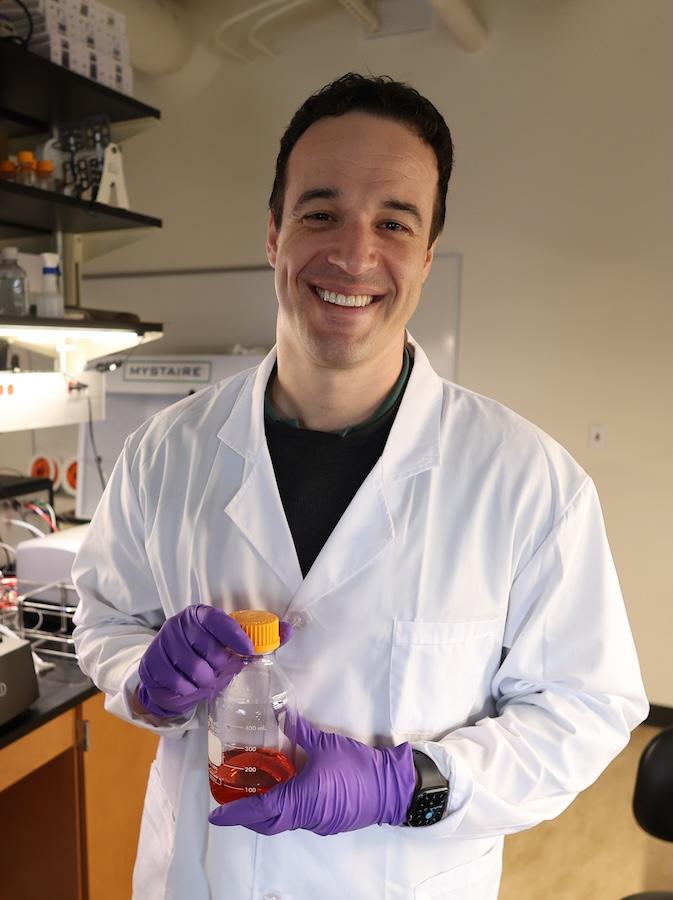
Samuel S. Urlacher, Ph.D.
- 2020-2021 Newsmaker of the Year
Samuel S. Urlacher, Ph.D., associate professor of anthropology, graduate program director and director of the Human Evolutionary Biology and Health Lab (HEBHL), was named Baylor University’s Newsmaker of the Year (2020-2021) for high-impact media coverage of his research that discovered evidence for a likely primary role of changing dietary intake – rather than reduced daily energy expenditure – in driving the rise in childhood obesity in many populations.
Urlacher is an anthropologist and human evolutionary biologist with an integrative biocultural research program. His lab aims to define the evolved energetic pathways that drive variation in human development, metabolism and health by measuring human energy expenditure (via doubly labeled water stable isotope tracking) and physiological biomarkers and hormones.
Published in The Journal of Nutrition, Urlacher’s 2021 study found that the variation in consumption of market-acquired foods outside of the traditional diet — but not in total number of calories burned daily — is reliably related to indigenous Amazonian children’s body fat. The subject of reporting by The New York Times, Urlacher’s research offered vital insight into the relative importance of diet versus energy expenditure for the rise in obesity.
Urlacher’s additional research has been featured by various national outlets, including ABC’s Good Morning America, Scientific American, Healthline, El País and The Chicago Tribune. He also is dedicated to science education/outreach and translational impact, participating in National STEM Day 2025 activities, where he and his students used hands-on activities to teach students about energetics, healthy eating and physical activity.
ABOUT SAMUEL URLACHER, PH.D.
Samuel S. Urlacher, Ph.D., associate professor of anthropology, graduate program director and director of the Human Evolutionary Biology and Health Lab (HEBHL), is an anthropologist and human evolutionary biologist with an integrative biocultural research program. His lab's primary aim is to define the evolved energetic pathways that drive variation in human development, metabolism and health by addressing a range of research questions that span the traditional disciplines of human biology, behavioral ecology, evolutionary medicine and global health. His long-term field research is performed collaboratively with Indigenous populations in Ecuador and Papua New Guinea, alongside other domestic and international projects that strive to reduce health disparities, especially in child health, and improve lives.
Urlacher’s research has been funded by the National Institutes of Health, National Science Foundation, Leakey Foundation, CIFAR, Jacobs Foundation, Czech Science Foundation and others. He is a founding faculty member of the Baylor Global Health Academy and advises students in health-related programs across the Baylor campus, including the McNair Scholars Program and Science Research Fellows. He co-directs the Shuar Health and Life History Project (Ecuador) and the Garisakang Evolutionary Anthropology Project (Papua New Guinea). He is an editor for the journals Annals of Human Biology, Scientific Reports and Human Behavior.