

Baylor Celebrates National STEM Day Through Partnership with Mart, McGregor & Midway ISDs
Baylor research faculty encourage next-generation STEM workforce through interactive, hands-on activities in health, computer science and chemistry
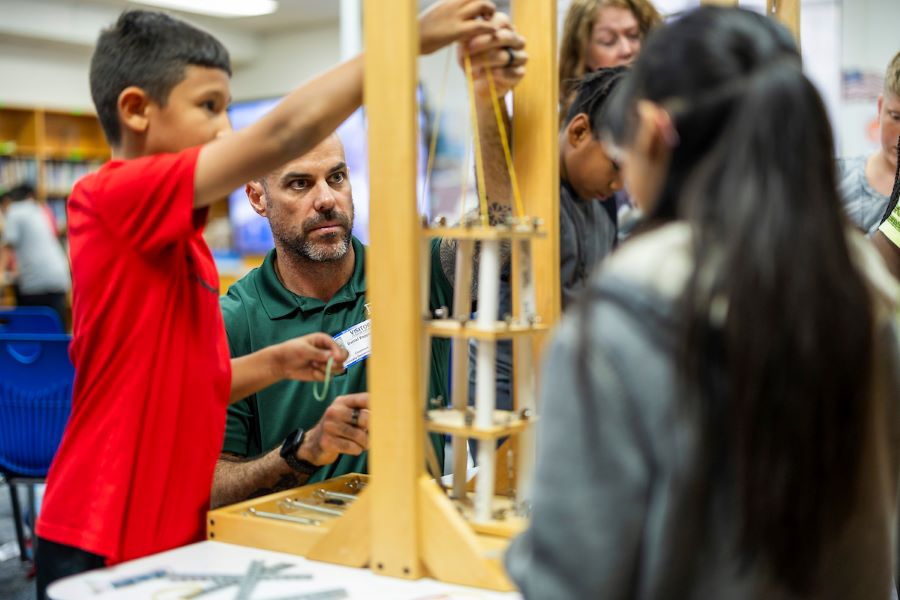
Geosciences professor Dan Peppe, Ph.D., simulates earthquakes with Connally Elementary students on an experiential geology station at a 2024 Baylor National STEM Day event. (Matthew Minard/Baylor University)
Contact: Kelly Craine, 254-297-9065
Follow us: @BaylorUMedia on X and LinkedIn
Baylor University is partnering with local schools leading up to this week’s National STEM Day to provide engaging science presentations for area students and teachers and connect Baylor researchers in the community. In partnership with Mart ISD, McGregor ISD and Midway ISD, Baylor research faculty will present grade-aligned, experiential projects to students at Mart Elementary School, McGregor Middle School and Midway High School to encourage an affinity for science, technology, engineering and math while demystifying careers in the STEM fields.
National STEM Day is an annual day of recognition on Nov. 8, designed to encourage participation in the STEM fields. The day provides an opportunity for schools and organizations to illuminate STEM opportunities and spark interest among students through projects and activities.
“It is important to encourage the next generation of the STEM workforce, and Baylor University wants to ensure that we’re helping raise up a community of students interested in science, technology engineering and math,” said Stacey Smith, Ph.D., assistant vice provost for research-research development in Baylor’s Office of the Vice Provost for Research (OVPR). “We’re excited to connect our tremendous Baylor faculty to serve students and teachers with engaging projects and are grateful for the opportunity to partner with area schools to make science come alive.”
Anthropologists, biochemists and computer scientists
This year’s Baylor faculty researchers participating in National STEM Day activities represent the disciplines of anthropology, biochemistry and computer science. Each has earned a national reputation within his or her field, and all have built significant research portfolios. The Office of Broader Impacts within Baylor OVPR partners with each faculty member to support grade-appropriate adaptations of their work to connect and share in local classrooms.
Three Baylor researchers will participate in this year’s National STEM Day activities:
Samuel Urlacher, Ph.D., associate professor of anthropology, conducts research at the intersection of anthropology and biology. He has led projects in South America and Papua New Guinea to study how children utilize calories and how experiences and economics impact metabolism. Urlacher earned a Michael A. Little Early Career Award from the Human Biology Association, and his work has been featured in top journals like Science and popular outlets, including ABC’s “Good Morning America” and The New York Times. On Wednesday, Nov. 5, he will lead students at Mart Elementary School in a series of activities to help them recognize the impact of healthy diet and physical activity.
Bryan F. Shaw, Ph.D., professor of chemistry and biochemistry, has built a dual-track research career at Baylor as a chemist and a champion for inclusion of those with disabilities in science. In 2008, his infant son, Noah, was diagnosed with retinoblastoma, a rare pediatric eye cancer. While Noah survived the disease, he lost sight in one eye. Shaw partnered to create an app enabling parents to screen photos for symptoms of retinoblastoma to catch the disease quickly. Since then, he has earned numerous high-profile grants for his work developing high-tech resources and lab accommodations to make science concepts and laboratories accessible to children with blindness or visual impairment. His work in this area has been published in elite journals such as Science Advances and covered in popular outlets, including NBC News and Texas Monthly. On Thursday, Nov. 6, Shaw will lead students at McGregor Middle School through a series of common lab activities with the use of assistive technologies to show students how individuals with disabilities can still participate in science careers.
Mary Lauren Benton, Ph.D., is a computer scientist with a focus on applications for human health. A Baylor graduate, she returned to her alma mater in 2020 after earning a Ph.D. in bioinformatics from Vanderbilt. Her research focuses on the application of computer science to interpret how DNA sequences alter genome function and impact disease risk and to advance understanding of gene regulation. Her work has appeared in Nature Reviews Genetics, and she was recently named a “KEEN Rising Star” by the Kern Entrepreneurial Engineering Network. The KEEN Rising Star recognition honors engineering educators who energize students with curiosity, creativity and connections that prepare them to innovate and create value in their communities On Friday, Nov. 7, Benton will lead students at Midway High School in interactive activities designed to help them develop precision, teamwork and logical questions to build computer applications that can serve others.
Computer science lesson plan
In addition, Baylor has provided instructions for a computer science-themed interactive activity that does not require a computer to fulfill. The lesson plan, selected by Benton, is designed to help students develop precision, teamwork and logical questions to build computer applications that can serve others. The lesson and instructions, available for download here, will be shared with high school students this week but can be used with younger students as well.
ABOUT BAYLOR UNIVERSITY
Baylor University is a private Christian University and a nationally ranked Research 1 institution. The University provides a vibrant campus community for 20,000 students by blending interdisciplinary research with an international reputation for educational excellence and a faculty commitment to teaching and scholarship. Chartered in 1845 by the Republic of Texas through the efforts of Baptist pioneers, Baylor is the oldest continually operating University in Texas. Located in Waco, Baylor welcomes students from all 50 states and more than 100 countries to study a broad range of degrees among its 12 nationally recognized academic divisions.