

A Train, a Solar Storm and an 185-Year-Old Mystery
Baylor researcher helps uncover the likely truth behind one of the earliest recorded examples of space weather disrupting technology
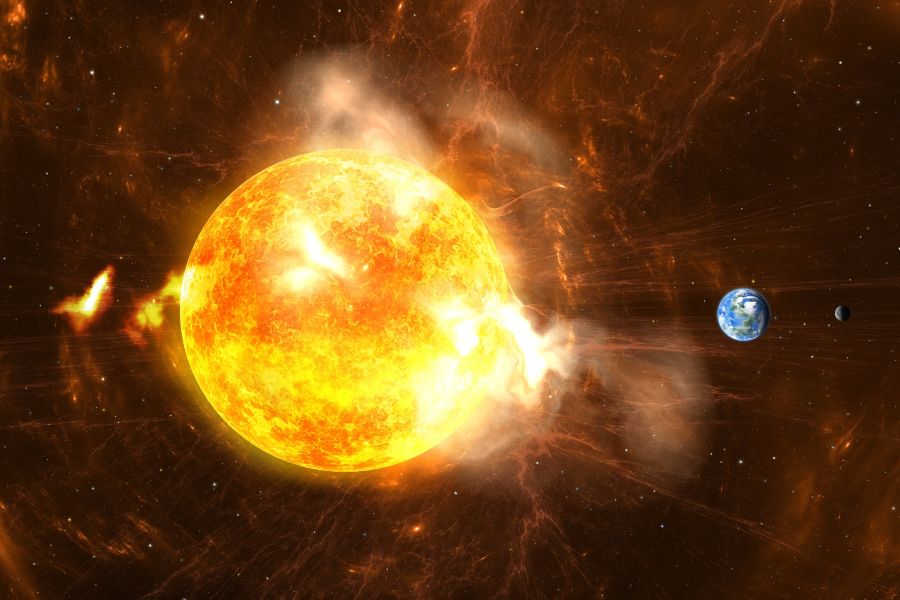
Visual of giant solar flares as the sun produces super-storms and massive radiation bursts. (Credit: Pitris / Collection: iStock / Getty Images Plus)
Contact: Kelly Craine, 254-297-9065
Follow us: @BaylorUMedia on X and LinkedIn
Nearly two centuries ago, a train scheduled to leave Exeter, England, at 10:05 p.m. sat motionless for 16 minutes.
The problem was not the train, the tracks or the weather on Earth. Instead, a powerful disturbance originating from the sun appeared to interfere with the railway’s telegraph system, preventing operators from confirming that the line ahead was clear.
The unusual delay has been described as the earliest known example of “space weather” disrupting human technology. But a new international study co-authored by space weather historian William B. (Trey) Cade III, Ph.D., of Baylor University’s Institute for Aviation Sciences reveals that an important detail in the historical account was wrong.
It could not have happened in 1841. The railway did not exist yet.
Published in the journal Space Weather, the study brings together researchers from Baylor, Lancaster University in the U.K., the British Geological Survey, Natural Resources Canada, RMIT University in Melbourne, Australia, and RAL Space in the U.K. Their investigation combined scientific observations with railway schedules, archival documents and 19th-century newspaper reports to solve the mystery.
“It’s a clear demonstration that, as soon as humans developed the first electricity-based technology, it became susceptible to disruption by large space weather events. That vulnerability has continued and increased to this day with so much of our technology: power grids, satellites, communications systems, GPS navigation and space travel.” - Trey Cade III, Ph.D., Institute for Aviation Sciences, Baylor University
“It’s a clear demonstration that, as soon as humans developed the first electricity-based technology, it became susceptible to disruption by large space weather events,” Cade said. “That vulnerability has continued and increased to this day with so much of our technology: power grids, satellites, communications systems, GPS navigation and space travel.”
A historical account that did not add up
The story can be traced to an article published by Nature in 1871. It described a “very intense magnetic disturbance” on Oct. 18, 1841, that interfered with telegraph equipment along the South Devon Railway.
Telegraph operators used electrical signals to communicate whether sections of track were clear. According to the account, the instruments malfunctioned so badly that the superintendent in Exeter initially thought someone was playing tricks with them. Unable to determine whether the track near Starcross was safe, railway officials delayed the train.
If the date was correct, the episode would be the earliest documented case of space weather affecting modern technology. Cade, whose research focuses on the history of space weather science, rediscovered the forgotten account, bringing renewed attention to its possible historical importance.
“I have researched numerous articles and newspapers from the 1600s to the 1800s to better understand how scientific understanding progressed,” Cade said. “When I came across the original Nature article, I published a paper about it in 2013, citing it as the earliest example I could find of space weather impacting technology.”
Cade was contacted by a research team after it uncovered a significant discrepancy. The railway line from Exeter through Starcross did not open until 1846, nearly five years after the reported incident. The team also found no evidence of unusual geomagnetic activity over England on Oct. 18, 1841. They invited Cade to join the investigation and help determine what actually occurred by identifying possible space weather events that could have inspired the original account and providing historical context for the research.
Finding the correct date
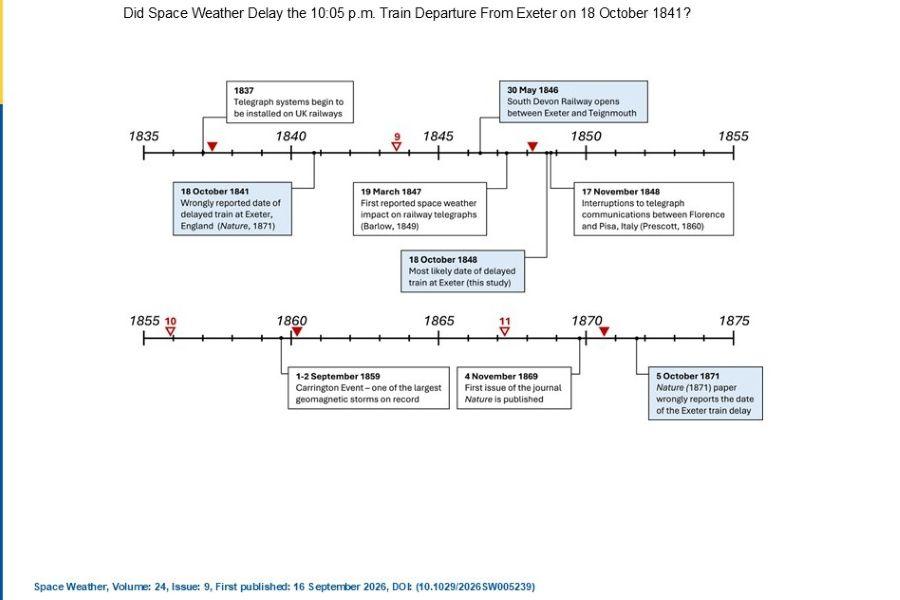
The train’s scheduled departure provided an important clue. Researchers examined historical railway timetables to determine if and when a 10:05 p.m. train left Exeter for communities along the route. That schedule was in place from 1848 and 1849. Their attention soon turned to Oct. 18, 1848, the same month and day reported by Nature, but exactly seven years later.
This time the evidence lined up.
Researchers discovered magnetic records from the Greenwich Observatory that showed powerful disturbances beginning during the evening of Oct. 18, 1848. Newspaper reports described brilliant auroras visible across England, while astronomical observations documented a large group of sunspots facing Earth.
Together, the records point to a period of intense solar activity capable of producing electrical currents that could interfere with telegraph equipment. The researchers concluded that the original Nature article most likely contained a typographical error, with “1848” mistakenly printed as “1841.”
An early warning from the sun
Space weather refers to changing conditions caused by activity on the sun. Solar eruptions can send charged particles and magnetic fields toward Earth, producing beautiful auroras but also disrupting technological systems.
In the 1840s, the electric telegraph was an emerging technology used by railways for communication and signaling. As telegraph networks expanded, the rise in solar activity exposed a vulnerability few people knew existed.
The corrected date means the Exeter delay was not the first recorded technological disruption caused by space weather. That distinction belongs to an event on March 19, 1847, when geomagnetic activity interfered with the Midland Railway’s telegraph system during a vivid auroral display. Still, the Exeter incident remains one of the earliest known examples of space weather affecting infrastructure, more than a decade before the famous Carrington Event of 1859 caused widespread telegraph disruptions.
The research also offers a lesson that extends beyond space science. Historical accounts, even those published in respected scientific journals, can contain errors that persist for generations. By comparing magnetic measurements with transportation records, solar observations and local news reports, the team was able to reconstruct what likely happened on that October night. The result is both a scientific correction and a compelling glimpse into the moment when humanity’s growing dependence on technology first collided with the power of the sun.
About the Authors
- William B. Cade III, Ph.D., Baylor Institute for Aviation Sciences, Baylor University School of Engineering and Computer Science, Waco, TX, USA
- James Wild, Ph.D., corresponding author, School of Physics and Astronomy, Lancaster University, Lancaster, UK
- Ciaran D. Beggan, Ph.D., British Geological Survey, Edinburgh, UK
- David H. Boteler, Ph.D., School of Physics and Astronomy, Lancaster University, Lancaster, UK, and Natural Resources Canada, Ottawa, ON, Canada
- Brett A. Carter, Ph.D., School of Science, RMIT University, Melbourne, VIC, Australia
- Michael Hapgood, Ph.D., RAL Space, STFC Rutherford Appleton Laboratory, Didcot, UK
ABOUT BAYLOR UNIVERSITY
Baylor University is a private Christian University and a nationally ranked Research 1 institution. The University provides a vibrant campus community for 20,000 students by blending interdisciplinary research with an international reputation for educational excellence and a faculty commitment to teaching and scholarship. Chartered in 1845 by the Republic of Texas through the efforts of Baptist pioneers, Baylor is the oldest continually operating University in Texas. Located in Waco, Baylor welcomes students from all 50 states and more than 100 countries to study a broad range of degrees among its 12 nationally recognized academic divisions. Learn more about Baylor University at www.baylor.edu.
ABOUT THE SCHOOL OF ENGINEERING AND COMPUTER SCIENCE AT BAYLOR UNIVERSITY
Baylor ECS is advancing as a premier School of Engineering and Computer Science in research and education with a commitment to Christian values. Majors include aerospace engineering, aviation sciences, bioinformatics, computer science, data science, cybersecurity, computer engineering, electrical and computer engineering, general engineering and mechanical engineering. ECS offers a number of graduate and Ph.D. programs, such as AI+, biomedical engineering and interdisciplinary degrees in Materials Science and Engineering. The School also offers graduate professional certificates. With more than 1,200 students, ECS stands out from the crowd through Christian commitment, R1 research, a caring community, small class sizes, personalized career support, 93%+ success rate, expert faculty and leading practical experience. Visit the ECS website to learn more and follow us on Instagram and Facebook.