

Stay Weather Ready: Severe Weather Awareness Week March 2-6, 2026
The National Weather Service says now is the time to prepare & Stay Weather Ready for spring storms
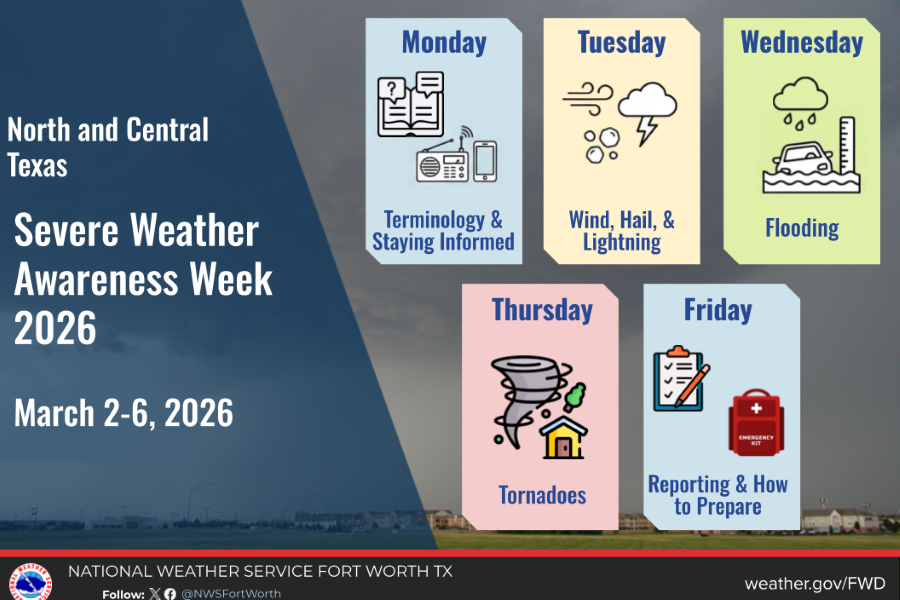
(Credit: weather.gov/FWD)
Contact: Baylor University Media & Public Relations, 254-710-1961
Follow us: @BaylorUMedia on X and LinkedIn
With severe weather season approaching in Texas, the National Weather Service in Fort Worth/Dallas will highlight severe weather topics and safety tips during Severe Weather Awareness Week, March 2-6, 2026. Ask yourself what YOU would do in case of severe weather. Do you have multiple ways to receive alerts? Do you have adequate shelter and supplies?
Throughout Severe Weather Awareness Week, the NWS Fort Worth/Dallas will share information on how you and your family can take steps to prepare now for severe weather this spring.
Monday – Preparedness / Baylor Alert Emergency Notification System
Preparation is key to staying safe and minimizing the impact of severe weather. The National Weather Service encourages taking these proactive steps now to help keep you, your family and your neighbors safe and informed during any storm:
- Be Weather Ready
- Sign Up for Notifications
- Create a Communications Plan
- Practice Your Plan
- Prepare Your Home
- Help Your Neighbor

The Baylor Alert system provides important information and instructions for students, faculty, staff and visitors for all types of hazards, including severe weather, but using multiple avenues to communicate:
- Outdoor Notification System (Main Waco Campus Only)
- Baylor Alert email notification to Baylor email account (from baylor@email.getrave.com)
- Baylor Alert text message to cellphone
- Audio message to a cellphone or other telephone
- Notices on Baylor’s main website (www.baylor.edu)
- Official Baylor social media channels: Facebook, X (formerly Twitter) and Instagram
- The Baylor Information Line audio recording at 254-710-4411
Tuesday – Flood Safety

The NWS notes that floods take the lives of more people in the United States each year than any other thunderstorm-related hazard. Many flood deaths are the result of people driving into flooded roads. Turn Around, Don't Drown!
For more information, check out the NWS Flood Safety Tips and Resources, including the difference between a flood watch and warning and what to do before, during and after a flood.
Wednesday – Tornado Safety
On average, Texas experiences more than 130 tornadoes each year. The NSW stresses preparing ahead now so these storms don’t take you by surprise. Know what to do before, during and after a tornado, as well as the difference between a Tornado Watch, a Tornado Warning and a Tornado Emergency.
“As we enter the spring storm season, Central Texas may experience severe weather, including tornadoes,” said George Nuñez, director of emergency management at Baylor. “It is important for students, faculty, staff and visitors to be familiar with the Baylor Alert emergency notification system and emergency preparedness guidance for severe weather, particularly if the National Weather Service issues a tornado watch or tornado warning.”
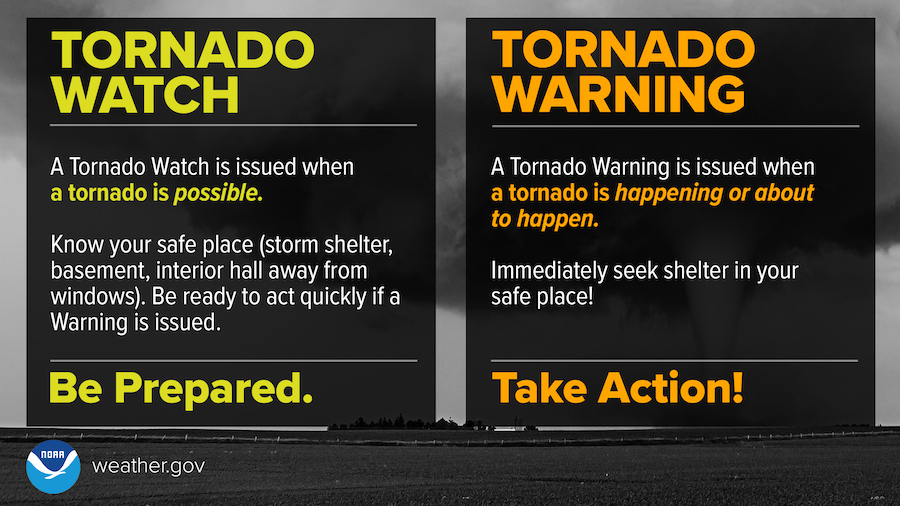
For the Baylor campus community, including students living in residence halls, now is the time to review Baylor’s tornado safety procedure guide and take advance actions:
- Check supplies, make sure your phone is charged and check the safe space in your home, apartment or residence hall.
- If you live in a Baylor residence hall, make sure you know where your Severe Weather Assembly Area is in your hall. These areas are identified on Building Emergency Plan maps throughout each building and also available via an online map.
- Be ready to act quickly if a warning is issued or you suspect a tornado is approaching.
Thursday – Hail/Wind Safety
Severe thunderstorms are capable of producing damaging hail and wind gusts. Hail an inch in size can damage property such as plants, roofs and vehicles. Strong winds over 58 mph can break off large branches, knock over trees or cause structural damage. Some severe thunderstorms can produce hail larger than softballs or winds over 100 mph, so it’s important to pay attention to the weather so you know when severe storms are possible.
Friday – Lightning Safety

Lightning strikes the United States about 25 million times a year. There is no safe place outside when thunderstorms are in the area. If you hear thunder, you are likely within striking distance of the storm. A good rule of thumb is: When Thunder Roars, Go Indoors!
In addition to the Baylor Alert emergency notifications system, Baylor’s lightning alert system – in partnership with Earth Networks, BUDPS, Baylor Athletics and Campus Recreation – consists of a lightning detector, audible tone and flashing strobe to alert individuals of lightning threats within an eight-mile radius. The automated outdoor alerting system for lightning covers various outdoor recreational and athletic locations.
Baylor University's Weather Station, powered by Earth Networks, is located at the Mayborn Museum and provides current on-campus weather conditions (temperature, wind speed, wet bulb globe temperature, etc.), radar, daily/hourly forecasts and any current weather alerts.
ABOUT BAYLOR UNIVERSITY DEPARTMENT OF PUBLIC SAFETY
The Baylor University Department of Public Safety serves as an umbrella department for the Baylor University Police Department, emergency management, physical and technical security and parking and transportation. BUDPS is set on providing students, faculty and alumni with excellent security and safety through instant notification systems, extensive surveillance cameras and highly trained staff.
ABOUT BAYLOR UNIVERSITY
Baylor University is a private Christian University and a nationally ranked Research 1 institution. The University provides a vibrant campus community for 20,000 students by blending interdisciplinary research with an international reputation for educational excellence and a faculty commitment to teaching and scholarship. Chartered in 1845 by the Republic of Texas through the efforts of Baptist pioneers, Baylor is the oldest continually operating University in Texas. Located in Waco, Baylor welcomes students from all 50 states and more than 100 countries to study a broad range of degrees among its 12 nationally recognized academic divisions. Learn more about Baylor University at www.baylor.edu.