

The Slippery Secret Beneath Japan’s Deadliest Earthquake
New insights in Science explain how a paper-thin layer of clay powered Japan’s most destructive earthquake
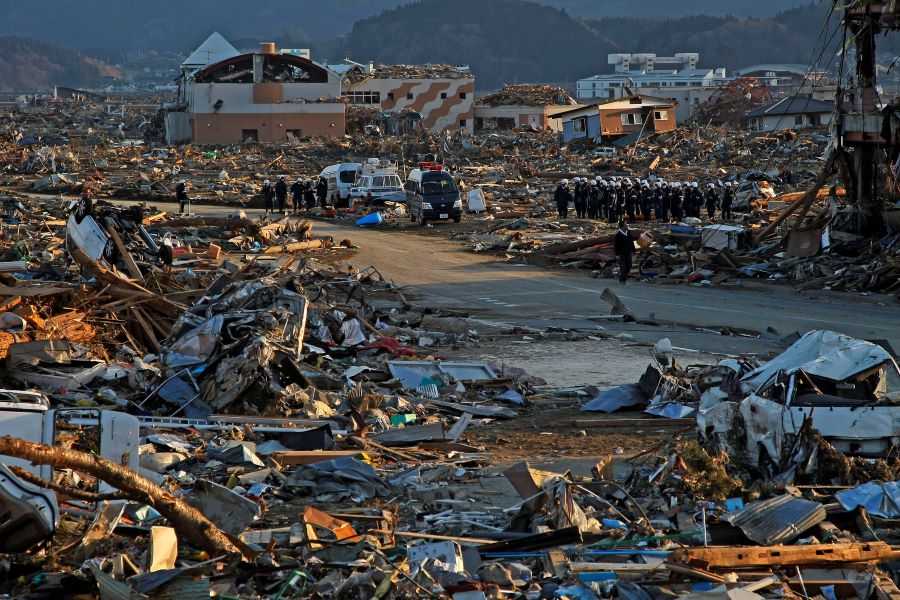
Debris and mud cover a city in Japan flattened by a massive tsunami in March 2011, caused by the energy released by a magnitude 9.0 earthquake - the biggest in the nation's recorded history and one of the five most powerful recorded ever around the world. (Credit: RyuSeungil / Collection: iStock Editorial / Getty Images Plus)
Contact: Kelly Craine, 254-297-9065
Follow us: @BaylorUMedia on X and LinkedIn
On March 11, 2011, Japan was struck by the most powerful earthquake ever recorded in the country: a magnitude 9.0 undersea earthquake about 45 miles off the Tohoku coast. Lasting nearly six minutes, the rupture triggered one of the most devastating natural disasters in modern history with a massive tsunami, widespread destruction, the Fukushima nuclear crisis and the loss of nearly 19,000 lives.
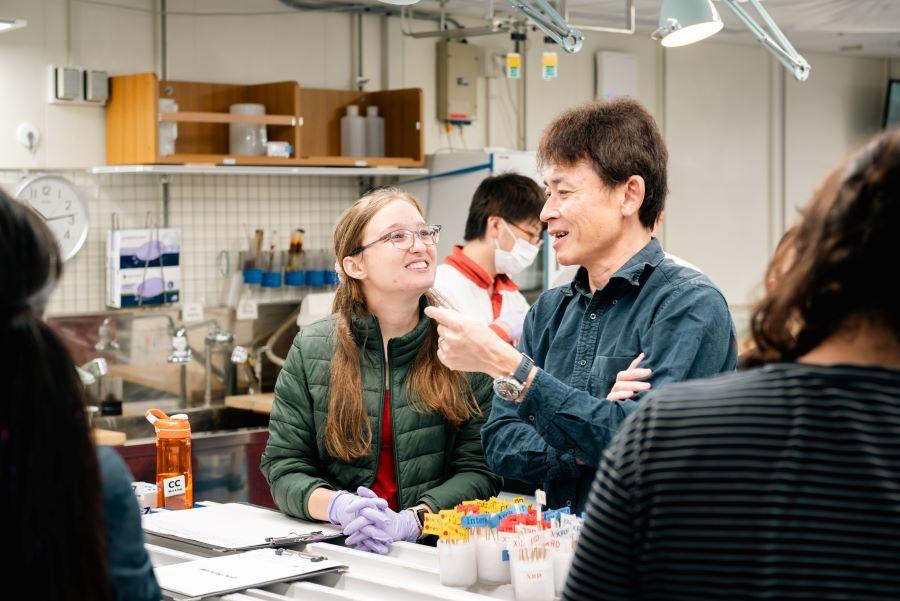
To understand why the Tohoku earthquake was so unusually powerful – and why it produced such a catastrophic tsunami – an international team of scientists launched an ambitious deep-sea drilling expedition. Among them was Catherine (Cat) Ross, Ph.D., assistant professor in the Department of Geosciences at Baylor University, whose work took her nearly four miles beneath the ocean surface and directly into the fault zone where the earthquake occurred.
Their findings – published in December 2025 in the journal Science – point to an unexpected culprit: a thin, slippery layer of clay buried deep beneath the Pacific Ocean floor.
A football field of motion
Even by global standards, the Tohoku earthquake was extreme. Along the fault where the Pacific Plate subducts beneath Japan, the two sides of Earth’s crust slid past one another by as much as the length of a football field.
“In most giant earthquakes, the largest slip happens deeper underground,” Ross said. “In this case, the biggest movement occurred very close to the seafloor – and that’s why the tsunami was so large.”
When a rupture reaches shallow depths, it displaces massive volumes of seawater, generating destructive tsunami waves. Understanding why the fault slipped all the way to the ocean floor became a central question driving the research.
Drilling into the fault zone
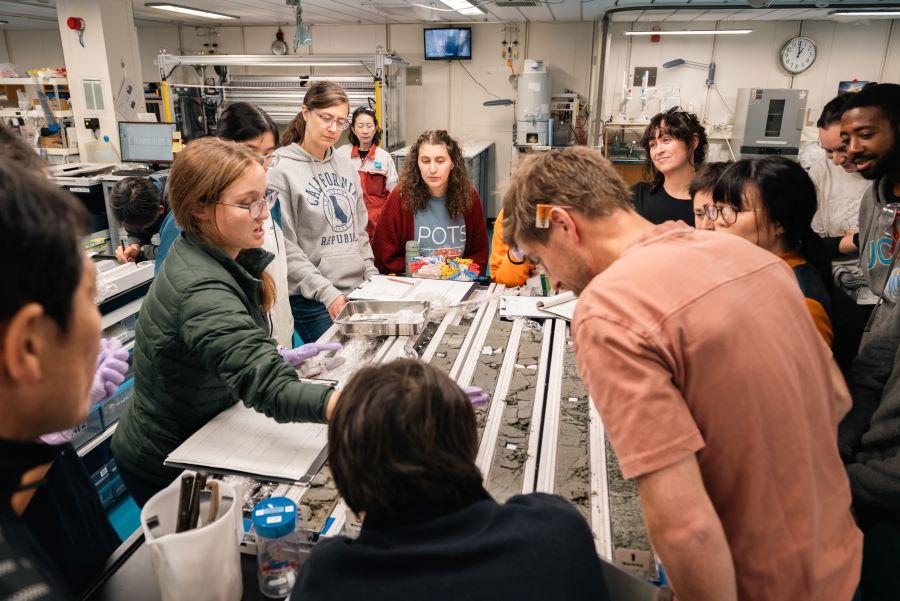
Ross was part of International Ocean Discovery Program Expedition 405, which returned to the Japan Trench more than a decade after the disaster. As researchers drilled through nearly four miles of water and sediment to reach the plate boundary fault, targeting a cone only a few meters wide sitting beneath over 6,000 meters of water in the open Pacific Ocean. Ross described re-entering one of the two an existing boreholes on the seafloor as “trying to thread cooked spaghetti into a straw while standing on a rolling chair and someone’s blowing a fan.” Despite the challenging deepwater conditions, the team successfully recovered rare core samples from the fault itself, offering a direct window into the earthquake’s mechanics.
The weakness beneath
At the heart of the fault lies pelagic clay, ultrafine sediment that slowly settles through the ocean over millions of years. Under microscopic examination, its particles slide easily past one another, providing very little resistance.
“It’s like slipping on mud or ice,” Ross said. “Once movement starts, it’s very easy to keep going until all the pent-up energy is released.”
The study found that the earthquake occurred along boundaries where stiff mudstones meet this weak clay, forming an exceptionally thin slip zone, sometimes only millimeters thick. When stress finally overcame friction, Ross said the fault followed this path of least resistance all the way to the seafloor, helping explain both the earthquake’s unusual behavior and the size of the tsunami.
Small clues, big consequences
Ross’s role focused on the smallest details of a massive event. By examining microscopic fault textures and fractures in split core samples, she helped reconstruct how materials behave under extreme stress.
“Earthquakes are huge, violent events,” she said, “but we study them by looking at features smaller than a grain of rice.”
The research carries lasting significance. During a post-expedition visit to tsunami-devastated areas near Sendai, Ross and the team of scientists saw firsthand the human cost – schools marked by high-water lines and rooftops where survivors waited for rescue.
“It’s easy to get wrapped up in the science,” she said. “But seeing that damage reminds you why this work matters.”
Earthquakes can’t yet be predicted, but understanding how they work helps improve hazard models, tsunami planning and early-warning systems – tools that can ultimately save lives, Ross said.
ABOUT CATHERINE (CAT) ROSS, PH.D.
Cat Ross, Ph.D., joined the Baylor University geosciences faculty in Fall 2025. Ross earned a B.S. and M.S. in Earth and Planetary Science from McGill University and Ph.D. in Geoscience at University of Texas at Austin, where she studied the impact crater that killed the dinosaurs. Ross then worked as a postdoctoral researcher at University of Wisconsin-Madison. Before arriving at Baylor, Ross received the prestigious NSF Postdoctoral Research Fellowship in Earth Science, investigating deformation in minerals that are used in age dating rocks.
ABOUT THE INTERNATIONAL OCEAN DISCOVERY PROGRAM EXPEDITION 405
The International Ocean Discovery Program Expedition 405 team involved scientists from the University of Nevada, Reno; University of California, Santa Cruz; Northern Arizona University; Utah State University; Baylor University; Kochi Institute for Core Sample Research, Japan Agency for Marine-Earth Science and Technology (JAMSTEC), Kochi, Japan; Heriot-Watt University, Edinburgh, UK; University of Tsukuba, Tsukuba, Ibaraki, Japan; The Australian National University, Acton, ACT, Australia; University of Lorraine, Nancy, France; Université Grenoble Alpes, Université Savoie Mont Blanc, Université Gustave Eiffel, ISTerre, Grenoble, France; University “G. d’Annunzio” of Chieti-Pescara, Chieti, Italy; Cornell University; MARUM-Center for Marine Environmental Sciences, University of Bremen, Bremen, Germany; Japan Agency for Marine-Earth Science and Technology (JAMSTEC), Yokosuka, Kanagawa, Japan; and Institute for Marine-Earth Exploration and Engineering (MarE3), Japan Agency for Marine-Earth Science and Technology (JAMSTEC), Yokosuka, Kanagawa, Japan.
ABOUT BAYLOR UNIVERSITY
Baylor University is a private Christian University and a nationally ranked Research 1 institution. The University provides a vibrant campus community for 20,000 students by blending interdisciplinary research with an international reputation for educational excellence and a faculty commitment to teaching and scholarship. Chartered in 1845 by the Republic of Texas through the efforts of Baptist pioneers, Baylor is the oldest continually operating University in Texas. Located in Waco, Baylor welcomes students from all 50 states and more than 100 countries to study a broad range of degrees among its 12 nationally recognized academic divisions. Learn more about Baylor University at www.baylor.edu.
ABOUT THE COLLEGE OF ARTS & SCIENCES AT BAYLOR UNIVERSITY
The College of Arts & Sciences is Baylor University’s largest academic division, consisting of 25 academic departments in the sciences, humanities, fine arts and social sciences, as well as 11 academic centers and institutes. The more than 5,000 courses taught in the College span topics from art and theatre to religion, philosophy, sociology and the natural sciences. The College’s undergraduate Unified Core Curriculum, which routinely receives top grades in national assessments, emphasizes a liberal education characterized by critical thinking, communication, civic engagement and Christian commitment. Arts & Sciences faculty conduct research around the world, and research on the undergraduate and graduate level is prevalent throughout all disciplines. Visit the College of Arts & Sciences website