

City of Waco Proclaims Robert Doyle Day Honoring Baylor Wetlands Researcher
Robert Doyle, Ph.D., professor of biology and founding director of CRASR, was honored by City of Waco for his long-standing efforts with the Lake Waco Wetlands
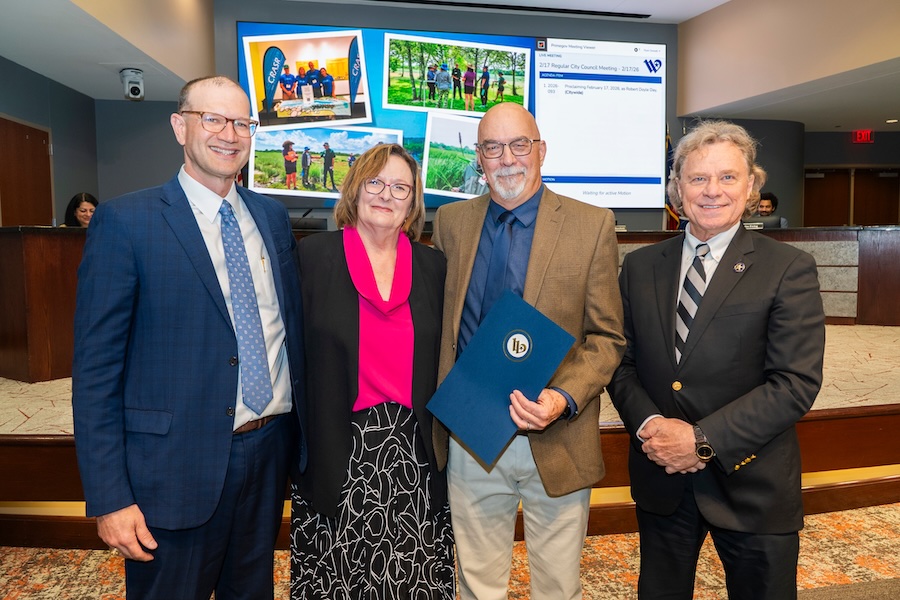
From L-R: Waco City Councilman Josh Borderud, Eva I. Doyle, Ph.D., Robert Doyle, Ph.D., and Waco Mayor Jim Holmes. (photo credit: City of Waco)
Contact: Shelby Cefaratti-Bertin, 254-327-8012
Follow us: @BaylorUMedia on X and LinkedIn
At a recent Waco City Council meeting, Waco Mayor Jim Holmes proclaimed Feb. 17, 2026, as Robert Doyle Day, recognizing the Baylor University researcher for his decades of service to Waco’s water systems and his role as one of the architects of the Lake Waco Wetlands project.
Robert Doyle, Ph.D., professor of biology and founding director of Baylor’s Center for Reservoir and Aquatic Systems Research (CRASR), played a key role in establishing the Lake Waco Wetlands and has led research efforts to enhance and expand the wetlands for more than 25 years.
Waco City Council Member Josh Borderud read the official City proclamation that described Doyle as “a dedicated scientist, passionate educator and tireless advocate for the preservation and restoration of wetland ecosystems.”
“Through his research, teaching, and community collaborations, he has advanced our understanding of aquatic plants, wetland function, and the critical importance of healthy water habitats. His efforts have included donating aquatic plants, guiding restoration projects, and supervising Baylor students and volunteers in meaningful, hands-on conservation work that supports the Waco Wetlands as a center for education, research, and environmental stewardship.
“Dr. Doyle’s lifelong commitment to wetlands began along the Amazon River in Manaus, Brazil, where he was raised by Southern Baptist missionary parents and immersed in the world’s largest tropical wetland. This exceptional upbringing shaped his passion for ecology and conservation and guided him toward a career devoted to protecting natural environments. Known affectionately as a “mudmucker” for his tireless work in the field, he has inspired generations of students and citizens through his humility, dedication, and service, and we encourage all citizens to join in celebrating his contributions to science, education, and environmental stewardship, honoring his enduring legacy in helping to create, preserve, and promote the Waco Wetlands as a lasting asset to our community.”
In an earlier council work session, Waco City Manager Ryan Holt highlighted Doyle’s impact the Lake Waco Wetlands, as well as his close working partnership with city staff, water utilities and Wetlands programming.
“He’s been a key contributor to water quality research and education, and we're grateful for his work and dedication to this important issue in our community,” Holt said.
Doyle traces his career in wetland ecology to his upbringing in the Amazon jungle, where his parents served as Southern Baptist missionaries. Surrounded by much water and rainforest, he developed a lifelong passion with ecological systems. He arrived at Baylor in 1976 as a biology undergraduate and later earned his master’s degree from the University. Though he left Baylor to earn his Ph.D. in environmental science, Doyle returned in 2001 to join the faculty.
"The partnership with the city, the institution and the people will be the shining part of my recollection of my academic career." - Robert Doyle, Ph.D.
“I came to Baylor because of the City of Waco,” Doyle said. “Tom Conry was here, and he convinced me that the City of Waco was taking water resources seriously and…making responsible choices. The partnership with the city, the institution and the people will be the shining part of my recollection of my academic career, and I am delighted that it is continuing with a new generation of professionals both at the city and at Baylor, so thank you so much; it's been an honor.”
Established in 2001, the Lake Waco Wetlands play a vital role in filtering up to 11 million gallons of water daily from the Bosque River, naturally removing nutrients and pollutants before they enter the lake. Created to offset habitat loss, this 180-acre wetland now serves as a vital ecological nursery, providing a home for diverse wildlife – including more than 132 bird species – while offering significant educational and recreational opportunities.
ABOUT THE CENTER FOR RESERVOIR AND AQUATIC SYSTEMS RESEARCH (CRASR)
The Center for Reservoir and Aquatic Systems Research (CRASR) at Baylor University is a specialized, interdisciplinary research center focusing on the ecology, hydrology, and ecotoxicology of aquatic ecosystems, particularly focusing on the freshwater to marine continuum. Based in the Baylor Sciences Building in Waco, Texas, CRASR bridges science and community through research on water quality, pollution, and climate change
ABOUT BAYLOR UNIVERSITY
Baylor University is a private Christian University and a nationally ranked Research 1 institution. The University provides a vibrant campus community for 20,000 students by blending interdisciplinary research with an international reputation for educational excellence and a faculty commitment to teaching and scholarship. Chartered in 1845 by the Republic of Texas through the efforts of Baptist pioneers, Baylor is the oldest continually operating University in Texas. Located in Waco, Baylor welcomes students from all 50 states and more than 100 countries to study a broad range of degrees among its 12 nationally recognized academic divisions. Learn more about Baylor University at www.baylor.edu.
ABOUT THE COLLEGE OF ARTS & SCIENCES AT BAYLOR UNIVERSITY
The College of Arts & Sciences is Baylor University’s largest academic division, consisting of 25 academic departments in the sciences, humanities, fine arts and social sciences, as well as 11 academic centers and institutes. The more than 5,000 courses taught in the College span topics from art and theatre to religion, philosophy, sociology and the natural sciences. The College’s undergraduate Unified Core Curriculum, which routinely receives top grades in national assessments, emphasizes a liberal education characterized by critical thinking, communication, civic engagement and Christian commitment. Arts & Sciences faculty conduct research around the world, and research on the undergraduate and graduate level is prevalent throughout all disciplines. Visit the College of Arts & Sciences website.