

Baylor University Innovation Fellows Launch Initiative to Reduce Dining Hall Food Waste
Student-led program uses research‑driven strategies to cut food waste and educate the campus community
(Photo credit: Baylor University Innovation Fellows)
Contact: Shelby Cefaratti-Bertin, 254-327-8012
Follow us: @BaylorUMedia on X and LinkedIn
Baylor University has launched a new, student-driven sustainability initiative aimed at dramatically reducing food waste in campus dining halls. The program, called Leave No Trace, introduces sampling stations, food-waste tracking systems and an educational campaign to help campus diners to make informed, sustainable dining choices. Developed and led by the inaugural cohort of the University Innovation Fellows (UIF), the efforts align with the Baylor in Deeds strategic plan by demonstrating Christian stewardship through academic-industry partnerships that advance sustainability solutions through research and implementation.
Baylor UIF students – part of a highly selective program at the Stanford d. school funded by the National Science Foundation –surveyed the entrepreneurial landscape at Baylor and identified an opportunity for impact. After learning that more than 360,000 pounds of food waste were diverted from landfills last year through Baylor’s composting efforts, the students zeroed in on how to reduce the amount of food waste in the first place.
“We were living in the residence halls and eating in the dining halls. It was a problem that was very salient to us,” said Spencer Yim, a junior University Scholar from Connecticut and member of UIF. “Even though we didn't see it firsthand, we could understand it and it was something tangible that we could interact with daily.”
Working closely with campus partners in Baylor Procurement, the Office of Sustainability and Baylor Eats, the student team developed 10 proposals based on nationwide research into reducing plate waste – the food left uneaten on diners’ plates. After a collaborative review, the group narrowed the focus to three core initiatives: Sic ’Em Sampling, Sic ’Em Scales and Sic ’Em Stats.
“From our research on things that had worked at other universities, we narrowed it down to three top goals,” Yim said. “The primary one is the sampling initiative, followed by waste tracking and a robust marketing campaign that puts the information in front of students so that they then can make informed decisions when they grab food in the dining hall.”
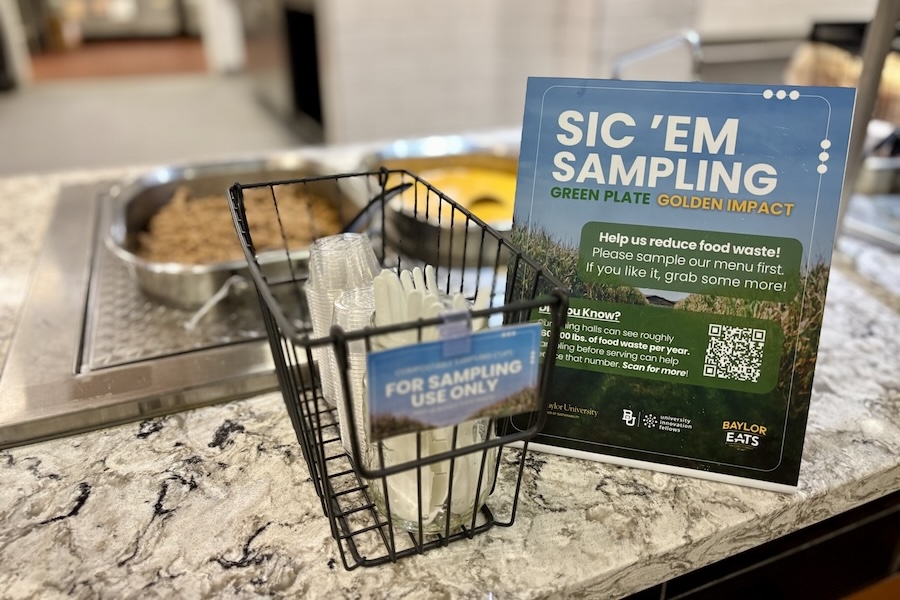
Sic ’Em Sampling
Following successful pilot studies in Fall 2025, the full sampling stations are now in place across Baylor’s three residential dining halls: Penland Crosslands, 1845 at Memorial and East Village Dining Commons. Each station offers small, compostable cups and spoons so diners can taste a dish before taking a full serving. The goal is to encourage students to start with smaller servings and reduce the amount of untouched food returned to the kitchen.
“It’s totally OK – even encouraged – that you take a smaller portion to start and come back for seconds,” Yim said.
Beyond sustainability, the team emphasizes that sampling can promote healthier eating habits. Many students feel obligated to finish everything on their plate, even when portions exceed their comfort level.
“We want to remove that issue,” Yim said. “If you feel like you must eat all of the stuff that's on your plate, you may be eating more than what your body can handle. We hope the initiative promotes healthier habits and improves sustainability.”
Sic ’Em Scales
To measure the impact of the sampling program, the team developed Sic ’Em Scales, a system to track plate waste daily. Dining associates will use back-of-house scales to weigh all food waste collected after each meal period before it goes to composting.
“There’s really no great system nationwide for tracking plate waste,” Yim said. “But this will allow us to analyze the impact sampling is making, where we need to focus efforts and even trends by meal period.”
Sic ’Em Stats
The third component, Sic ’Em Stats, focuses on educating diners by displaying up-to-date food waste data.
New TV screens – sponsored by Campus Services and UIF fundraising – display educational content encouraging participation in Leave No Trace. As more data is collected, the screens will shift into real-time dashboards showing waste metrics broken down by dining hall – potentially introducing an element of friendly competition.
Leave No Trace
Together, the initiative creates a dynamic program to reduce food waste, measure impact and educate students, faculty and staff about making healthier, more sustainable food choices. Inspired by the idea of “Bears leaving a campsite cleaner than they found it,” the UIF team has looked at every angle, including working with campus dietitians to ensure all messaging is thoughtfully crafted to avoid negatively affecting students with eating challenges.
The project also includes an academic component, with two research papers underway. One focuses on the process, and the other focuses on the impact, both the quantitative impact and the feedback from students.
“Serving as a campus partner and mentor, it has been a great honor to work alongside the University Innovation Fellows,” said Wil Campos, assistant director of Campus Services at Baylor. “I am very proud of the work that the UIF has been able to accomplish up to this point and look forward to their progress.”
Chartwells, the national parent company of Baylor Eats, also sees promise – and potential – to replicate the Baylor model at other universities.
“Working with the University Innovation Fellows has been an energizing and collaborative experience,” said Jennifer Crawford, Vice President of Operations for Baylor Eats. “Their creativity, curiosity and commitment to improving the student experience brought fresh perspectives to the Baylor Eats dining program with a solutions-oriented mindset, and their ability to translate ideas into actionable strategies helped build momentum quickly.”
As momentum builds, the fellows hope their work will be integrated into Baylor’s long-term operational strategy and support broader institutional goals around stewardship and sustainability.
“Hopefully this transformation from being student‑led to being institutionally led,” Yim said. “We want it to become an established part of Baylor’s dining operations – and eventually, something that makes a difference at schools across the nation.”
ABOUT BAYLOR UNIVERSITY
Baylor University is a private Christian University and a nationally ranked Research 1 institution. The University provides a vibrant campus community for 20,000 students by blending interdisciplinary research with an international reputation for educational excellence and a faculty commitment to teaching and scholarship. Chartered in 1845 by the Republic of Texas through the efforts of Baptist pioneers, Baylor is the oldest continually operating University in Texas. Located in Waco, Baylor welcomes students from all 50 states and more than 100 countries to study a broad range of degrees among its 12 nationally recognized academic divisions. Learn more about Baylor University at www.baylor.edu.