

Baylor University Celebrates Grand Opening of ARKTOS Research Center
Based in Central Texas, ARKTOS pioneers research and technologies to help military and civilian teams rapidly prepare for Arctic deployment
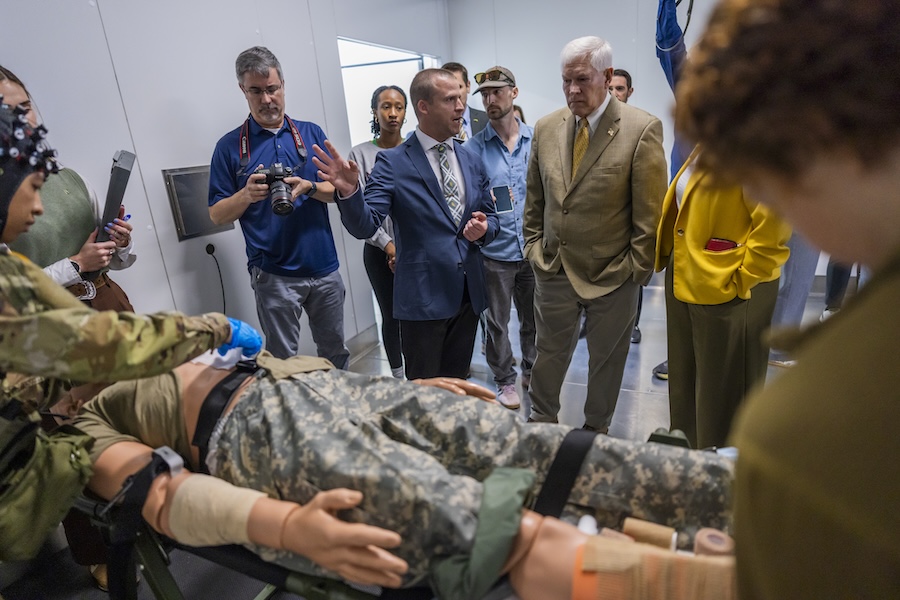
ARKTOS co-director and Baylor professor Dr. Cory Smith leads a press tour of an Arctic environmental chamber for Congressman Pete Sessions (TX-17) during the research center's grand opening. (Matthew Minard/Baylor University)
Contact: Lori Fogleman, 254-709-5959
Follow us: @BaylorUMedia on X and LinkedIn
Baylor University debuted a first-of-its-kind research and development center on April 13 with the grand opening of the Arctic Acclimatization & Sleep Optimization (ARKTOS) Research Center in the Baylor Research and Innovation Collaborative (BRIC). ARKTOS is an advanced, collaborative research and testing facility that will develop knowledge products and biomedical technologies that assess and mitigate the impact of multi-stressor Arctic environments on sleep, cognition and human performance.
Representatives from Baylor University, along with Congressman Pete Sessions (TX-17) marked the opening of the ARKTOS Research Center with a tour of Phase I of the project while also building anticipation for Phase II of ARKTOS that will add to the research center’s current capabilities.
“We believe that Baylor is uniquely positioned to help address our nation’s greatest challenges through our research. That belief is grounded in the work of our faculty who are engaged in cutting-edge research on important and timely topics in a wide variety of disciplines across our colleges and schools,” said Baylor President Linda A. Livingstone, Ph.D. “As a Christian Research I university, we are really excited to add this important research facility at the BRIC, and we’re honored to launch the first phase of the center that will equip the service members of the U.S. military to handle complex, multi-sensory environments.”
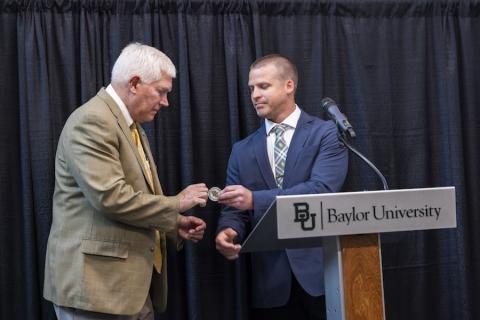
The April 13 event also included a special ceremony, highlighted by the presentation of the center’s first challenge coin to Congressman Sessions in recognition of his support of ARKTOS and Baylor University research.
“I was pleased to receive a tour of the ARKTOS Research Center at the Baylor Research and Innovation Collaborative in Waco, Texas, where I was able to see the only lab in the world with the capabilities to study both extreme cold temperatures and altitude stressors to human performance and function, and soon they will also be able to simulate these adverse conditions to the human body under transport,” Congressman Sessions said. “Supporting this Christian university research facility is something that I am very happy to do, as they continue to raise the bar in research and development that will benefit our United States Armed Forces, the men and women who will be tasked with protecting us and furthering our national security interests. The leadership and expertise at Baylor University are an outstanding example of world-class education and growth in strategic partnerships.”
Funded by $1 million secured by Congressman Sessions in the FY 2024 appropriations bill, ARKTOS Phase I includes the development of an Arctic environmental chamber that can hold temperatures down to -30 degrees Celsius (-22 degrees Fahrenheit) and simulate altitude by controlling oxygen levels. The chamber also is outfitted with physiological monitoring systems that can withstand cold-weather operations.
“ARKTOS aims to provide a first-of-its-kind research and development center to test and develop protocols and technologies that will help both military personnel and civilians be more prepared for the rapid acclimatization that might be necessary for Arctic deployment” - Jason R. Carter, Ph.D., dean of Robbins College of Health and Human Sciences.
“ARKTOS aims to provide a first-of-its-kind research and development center – right here in Central Texas – to test and develop protocols and technologies that will help both military personnel and civilians be more prepared for the rapid acclimatization that might be necessary for Arctic deployment,” said Jason R. Carter, Ph.D., dean of Robbins College of Health and Human Sciences. “The facility will also allow us to harden medical technologies that are not equipped to operate optimally in the Arctic and will even allow us to develop and validate screening protocols for ‘cold-weather phenotyping.’”

Co-directed by Carter and Associate Professor Cory M. Smith, Ph.D., the ARKTOS chamber provides researchers with a space to study rapid acclimatization, combat casualty care, tactical decision making, sleep optimization and field-based biomedical device testing.
“It has been reported that eight of every 12 potentially survivable injuries in recent conflicts might have been prevented with proper tactical combat casualty care at the point of injury,” Smith said. “The ARKTOS Research Center aims to reduce that ratio by optimizing medical provider performance in austere environments, creating hyper-realistic simulations mimicking challenging operational environments such as cold and high altitude. The data and research we obtain will be used to optimize patient care and allow medical providers to thrive in these environments.”
In addition, ARKTOS provides federal, industry and academic collaborators with access to capabilities, resources and subject-matter experts that would otherwise be cost-prohibitive.
With Phase I complete, ARKTOS is positioned for the launch of Phase II through $2 million secured by Congressman Sessions in the FY 2026 appropriations bill. Phase II will build upon the abilities of Phase I by adding a state-of-the-art Arctic Motion Simulation Chamber, which will simulate extreme environmental conditions and dynamic operational scenarios encountered in military and civilian emergency response teams.
The chamber will combine environmental simulation technology with an advanced motion platform to create an unparalleled training environment capable of simulating ground transport, air transport (up to 24,000 feet in altitude), snow and mountain sides. Researchers will utilize the space to investigate human performance and medical technology functionality across diverse operational conditions in a realistic, yet controlled, environment.
ABOUT BAYLOR UNIVERSITY
Baylor University is a private Christian University and a nationally ranked Research 1 institution. The University provides a vibrant campus community for 20,000 students by blending interdisciplinary research with an international reputation for educational excellence and a faculty commitment to teaching and scholarship. Chartered in 1845 by the Republic of Texas through the efforts of Baptist pioneers, Baylor is the oldest continually operating University in Texas. Located in Waco, Baylor welcomes students from all 50 states and more than 100 countries to study a broad range of degrees among its 12 nationally recognized academic divisions. Learn more about Baylor University at www.baylor.edu.
ABOUT ROBBINS COLLEGE OF HEALTH AND HUMAN SCIENCES AT BAYLOR UNIVERSITY
Established in 2014, Robbins College of Health and Human Sciences seeks to enhance health, quality of life and human flourishing for all individuals and communities through education, research and innovation. It includes six academic departments – Communication Sciences and Disorders; Health, Human Performance, and Recreation; Human Sciences and Design; Occupational Therapy; Physical Therapy; and Public Health – along with the Division of Health Professions, which houses the Master of Physician Assistant Studies program. Robbins College offers 13 bachelor’s degrees, 10 master’s degrees and six doctoral degrees, as well as nine graduate programs in partnership with the U.S. Army. Graduate programs in Robbins College are offered in a variety of modalities, including on campus, online and hybrid. For more information, visit the Robbins College website.