

Baylor Regents Celebrate Forward Momentum in Graduation Rates, Fundraising and Research
Board approves undergraduate degree, sets tuition and fees for 2026-27, affirms new Faculty, Student and Alumni-Elected Regents
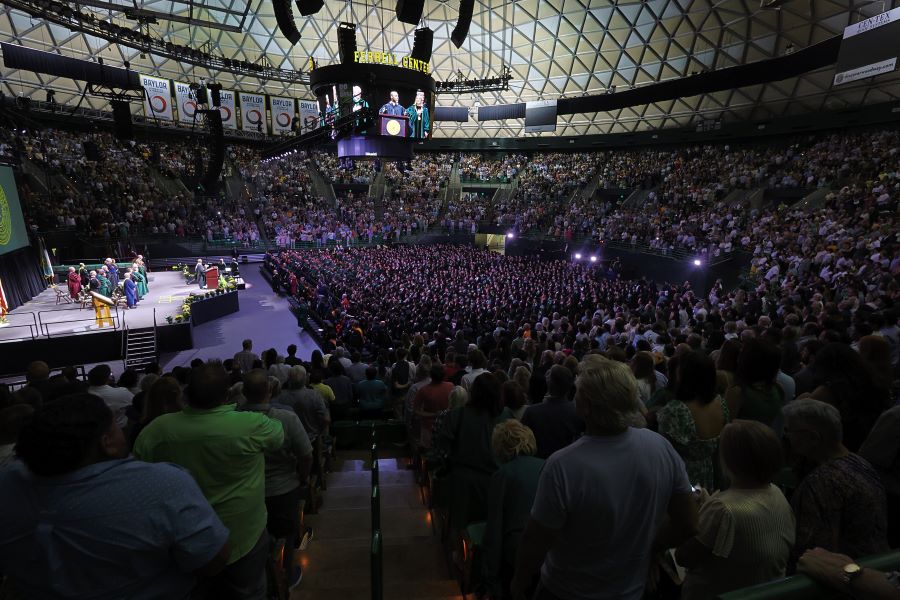
In May 2025, Baylor University celebrated commencement with more than 4,000 Baylor graduates, the largest class in University history. (Robert Rogers/Baylor University)
Media Contact: Lori Fogleman, 254-709-5959
Follow us: @BaylorUMedia on X and LinkedIn
During its regular February meeting, the Baylor University Board of Regents took several actions that will continue to strategically position the University for the future in areas related to academics and research and value and affordability. The Board also celebrated record four-year graduation rates, a strong fundraising year and an expanding research enterprise, while also setting tuition and fees for 2026-27.
The Board received several updates that underscored the University’s financial health and stability in essential areas such as student success, philanthropy and research, which is critically important given the many headwinds and uncertainties facing colleges and universities across the country. Baylor’s record four-year graduation rate is now 77.3%, set in 2025 for first-year freshmen who entered Baylor in Fall 2021. In addition, external support for Baylor research continues to expand, with grants and awards projected to be $59.8 million, the second highest amount ever.
Baylor’s 2025-26 fundraising year is shaping up to be the second most successful ever, headlined by January’s $30 million gift from the Moody Foundation of Galveston to support scholarships, research and academic programs in the School of Education, now known as the Moody School of Education. In addition, the Extend the Line Scholarship Initiative, which aims to raise $250 million for student scholarships by 2030, has secured more than $100 million since being announced last February.
“The Board of Regents is deeply appreciative of the leadership of President Livingstone, our faculty and staff and the Baylor Family for coming alongside in support of the University and our mission to educate men and women for worldwide leadership and service within a caring Christian community,” said Board of Regents Chair William “Bill” E. Mearse, B.B.A. ’78, M.B.A. '79, of Houston. “The University’s momentum under the Baylor in Deeds strategic plan continues, and as Baylor faces many of the same challenges as other higher education institutions, the Board remains focused on being good stewards of the resources entrusted to us by students and their families and to ensure they are prepared to lead now and into the future.”
Board approves new degree in biomedical engineering, sets 2026-27 tuition and fees
Regents approved a Bachelor of Science in biomedical engineering in Baylor’s School of Engineering and Computer Science, strategically positioning the University to meet the growing workforce demand for biomedical engineers in Texas and beyond. Driven by advances in healthcare technology, medical devices and data-enabled medicine, the degree strengthens and expands Baylor’s engineering and related programs, which are identified as priority growth areas in Baylor in Deeds.
The Board also approved an increase in Baylor’s tuition and fees for the upcoming 2026-27 academic year. After accounting for financial aid and extensive need-based and merit scholarship opportunities, the average net out-of-pocket increase in tuition and fees per incoming student is expected to be $1,978 annually.
To assist current students, prospective students and their families in managing this increase in tuition and fees, Baylor will:
- Increase scholarship funding by $3.8 million to provide assistance for returning students with demonstrated financial hardship.
- Extend some form of financial aid to more than 90% of students, which means the large majority of students will not pay the full sticker price to attend the University. The sticker price for Baylor’s tuition and fees will increase from $63,620 in 2025-26 to $67,756 next academic year.
- Remain focused on the median out-of-pocket price for a Baylor education for students and families with a household income of $300,000 or less. Baylor’s median out-of-pocket price has essentially remained constant or decreased for this income group annually since 2019.
- Continue the Baylor Benefit Scholarship – now in its fourth year – which covers tuition and fees for selected incoming students with demonstrated financial need and an adjusted household income of $50,000 or less.
- Continue to support the Extend the Line Scholarship Initiative, which has exceeded in raising more than $100 million over the past year.
- Identify campus operational efficiencies as part of a strategic budget repositioning toward enhancing students’ affordability and value.
“It is never an easy decision for our University administration and the Board of Regents to increase tuition and fees, and our focus remains providing our students with a nationally recognized transformational educational experience while maintaining Baylor’s distinct place in higher education as a Christian R1 university,” President Linda A. Livingstone, Ph.D., said. “We are fully committed to Baylor’s value and affordability, and we are working diligently to reduce expenses campuswide through a strategic budget assessment process, increase scholarships, grow our endowment and identify new revenue sources that will allow us to slow and reduce the rate of annual tuition increases for students and families.”
President Livingstone added that as a private university, Baylor receives only a small amount of financial support from the State of Texas through the Tuition Equalization Grant scholarship program for select students. The University’s primary sources of revenue are tuition and the generous philanthropic support of alumni and friends, not state appropriations as with public colleges and universities.
According to U.S. News & World Report, Baylor’s first-year experience and living learning communities both rank in the Top 10, just behind schools like Vanderbilt University and Yale University. Baylor is No. 1 in Texas, No. 1 in the Big 12 Conference and No. 1 among all large private universities. In addition, Baylor’s undergraduate teaching, innovation and undergraduate research/creative projects are all ranked in the Top 40. Overall, Baylor continues to boast a Top 50 private ranking and is the Top Producer of Fulbright Scholars in the state and Big 12, also ranking in the Top 10 nationally.
Apart from rankings, Baylor boasts a 92% placement rate, and its success rate is 94%, which are both well above the national average. Placement rate refers to students earning jobs in their field of study, while success rate includes employment of any kind, graduate school and internships. TIME has named Baylor a Best College for Future Leaders three years in a row, and The Princeton Review lists Baylor as a Best Value.
Board tours new Clinical Simulation and Skills Facility, experiences Chapel
On Thursday, Regents toured Baylor’s new Clinical Simulation & Skills Facility in Robbins College of Health and Human Sciences, which integrates high-tech simulation technology with immersive training for future healthcare professionals. Replicating real-world medical settings, the facility features high-fidelity “manikins” that simulate patients of all ages with the ability to present a wide range of ailments and conditions.
The Board also participated in Chapel Experiences with University Chaplain Charley Ramsey, Ph.D., Erin Moniz, D.Min., director of Chapel and associate chaplain, and various Chapel leaders. Informed by Baylor’s longitudinal Faith and Character Study, Chapel at Baylor has been transformed into nearly 70 different Chapel Experiences, including traditional worship services, profession-specific chapels, chapels for creatives, special-interest chapels and more. The Board experience created an opportunity for Regents to explore how Chapels in different, more personalized forms continue to nurture students’ faith, foster community and create space for a deeper understanding of Christianity.
Affirmation of Student, Faculty and Alumni-Elected Regents
Baylor Regents approved Chase R. Cortner, a junior management and philosophy major from Tampa, Florida, as a new first-term, non-voting Student Regent, beginning June 1; Student Regent Spencer Yim, a junior University Scholar from Connecticut, as a second-term voting Student Regent through 2027; and Chris Hansen, M.F.A., professor and chair of the Department of Film & Digital Media in the College of Arts & Sciences, for a three-year term as Faculty Regent.
The Board affirmed Susan “Suzii” Youngblood March, B.A. ’72, of Kerrville, Texas, a policy consultant for the H.E. Butt Foundation in San Antonio, who was elected by Baylor alumni to a three-year term as an Alumni-elected Regent. Her term will begin on June 1.
Youngblood March received 1,716 votes of the 3,919 Baylor graduates who voted in the spring election, which was administered and certified by the independent firm YesElections. Other alumni-elected Regent candidates included:
- Brian A. Aslin, B.F.A. ’13, J.D. ’16, of Austin, Texas; an attorney in the Austin office of Jackson Lewis; and
- Christine Stucker Klote, B.B.A ’84, M.B.A. ’96, of Fort Worth, Texas; senior vice president of Texas Highway Products for Race Rock.
President Livingstone’s regular report
The Board also received President Livingstone’s regular report, which included updates on several of her annual goals. She highlighted opportunities to advance Baylor’s Christian mission and institutional identity, including her appointment to the Executive Committee of the North American Baptist Fellowship and the continued important relationship between Baylor and the Council on Christian Colleges and Universities.
President Livingstone’s report also included a brief update on intercollegiate athletics, including the well-received hiring of Doug McNamee as Vice President and Director of Intercollegiate Athletics. She also reiterated Baylor’s forward momentum relative to graduation, retention, fundraising and research. Finally, President Livingstone remarked on the energy and excitement – for both the University and the City of Waco – generated by high-profile concerts and live entertainment at Baylor’s Foster Pavilion and McLane Stadium.
ABOUT BAYLOR UNIVERSITY
Baylor University is a private Christian University and a nationally ranked Research 1 institution. The University provides a vibrant campus community for 20,000 students by blending interdisciplinary research with an international reputation for educational excellence and a faculty commitment to teaching and scholarship. Chartered in 1845 by the Republic of Texas through the efforts of Baptist pioneers, Baylor is the oldest continually operating University in Texas. Located in Waco, Baylor welcomes students from all 50 states and more than 100 countries to study a broad range of degrees among its 12 nationally recognized academic divisions. Learn more about Baylor University at www.baylor.edu.