

Baylor-Led Archaeological Team Discovers Second Intact Etruscan Chamber Tomb in Italy
New discovery builds on a decade of interdisciplinary research and offers rare opportunity to understand complex Etruscan funerary rituals
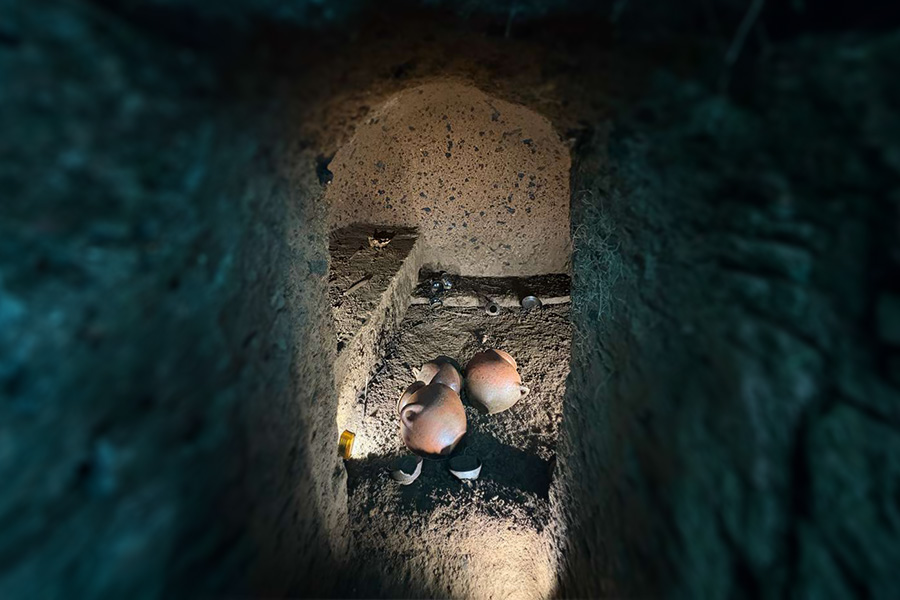
A first glimpse into the newly discovered Etruscan chamber tomb. (Photo credit: SGARP)
Contact: Shelby Cefaratti-Bertin, 254-327-8012
Follow us: @BaylorUMedia on X and LinkedIn
Just one year after uncovering a rare intact Etruscan chamber tomb in central Italy, a Baylor University-led archaeological team has made another remarkable discovery.
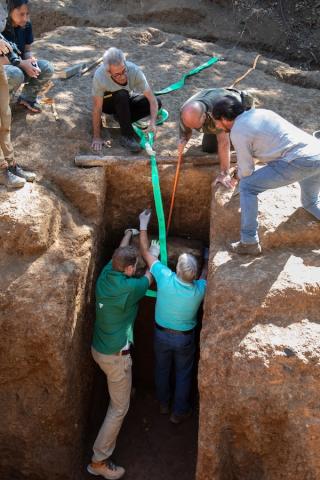
Researchers with the San Giuliano Archaeological Research Project (SGARP) uncovered a second undisturbed chamber tomb dating to the late seventh century B.C. at the San Giuliano necropolis near Barbarano Romano, Italy. The discovery gives archaeologists a rare opportunity to compare two untouched Etruscan tombs from the same period while offering new insight into the lives, beliefs and burial traditions at a time when many important transformations were occurring in the Etruscan culture – for instance, the introduction of new feasting traditions from Greece and architectural shifts from huts to rectangular houses that are reflected in the tomb architecture.
SGARP is an interdisciplinary international collaboration between a Baylor University-led consortium of universities and Virgil Academy in Rome, operating in full partnership with the town of Barbarano Romano and under the auspices of the Soprintendenza Archeologia Belle Arti e Paesaggio per la provincia di Viterbo e per l’Etruria Meridionale.
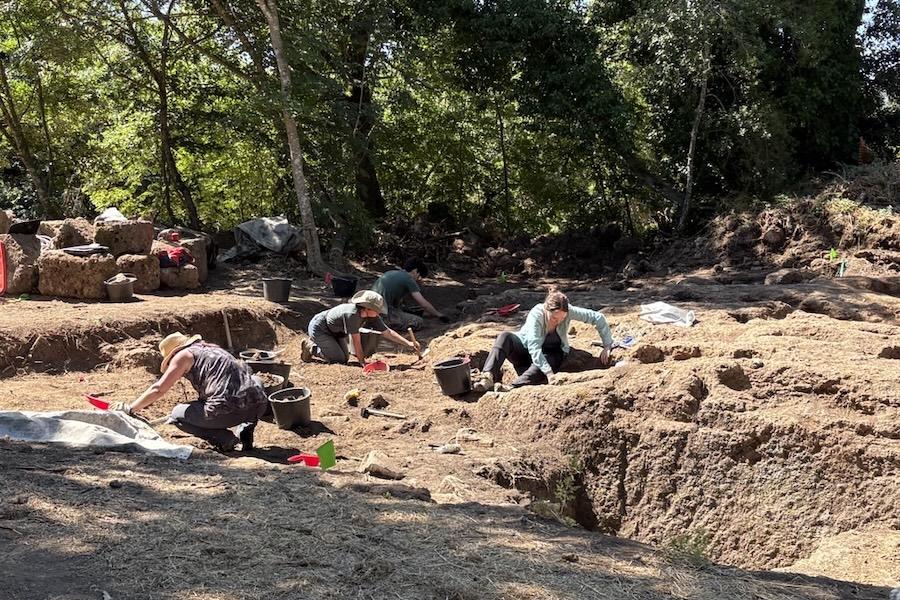
Now in its 10th year, the transdisciplinary research program and field school brings together archaeologists, historians, anthropologists, art historians, conservators, scientists and Baylor students to investigate one of the most important Etruscan landscapes in central Italy, located approximately 70 km northwest of Rome, within Marturanum Park in the province of Lazio. The project also serves as Baylor University's Archaeology Research in Italy study abroad program, allowing students to contribute to internationally significant archaeological research while working alongside faculty and specialists from around the world.
"Discovering a second intact tomb is incredibly exciting, but what makes it truly significant is what it allows us to learn." - Davide Zori, Ph.D.
"Discovering a second intact tomb is incredibly exciting, but what makes it truly significant is what it allows us to learn," said Baylor University’s Davide Zori, Ph.D., project director and principal investigator, professor of history and archaeology in the Baylor Interdisciplinary Core (BIC)/Honors College.
"These are the first intact tombs from this period in inland Etruria to be excavated using modern archaeological methods,” Zori said. “Together, they give us a unique opportunity to study ritual practices, belief systems and the relationships the Etruscans at the inland site of San Giuliano had with neighboring communities in the interior of Etruria as well as along the Tyrrhenian coast during a period of tremendous cultural change at the end of the seventh century B.C."
In addition to Davide Zori, project leaders include Colleen Zori, Ph.D., principal investigator and senior lecturer in the BIC and anthropology; Jamie Aprile, Ph.D., co-principal investigator and adjunct lecturer in the BIC; Jerolyn E. Morrison, Ph.D., laboratory director of SGARP and assistant professor of art history in Baylor's College of Arts & Sciences; and Veronica Ikeshoji-Orlati, Ph.D., ceramicist and co-principal investigator.
Another rare look inside an Etruscan tomb
The team discovered the new chamber tomb within a tumulus dug out of the bedrock atop the Caiolo plateau, one of several hills surrounding the Etruscan city and into which the Etruscans dug the tombs that make up the San Giuliano necropolis. Dating to the late seventh century B.C., the tomb discovered and excavated in 2026 represents a transitional architectural style, featuring a roof carved to resemble a hut and a single funerary bed carved along the north side of the chamber.
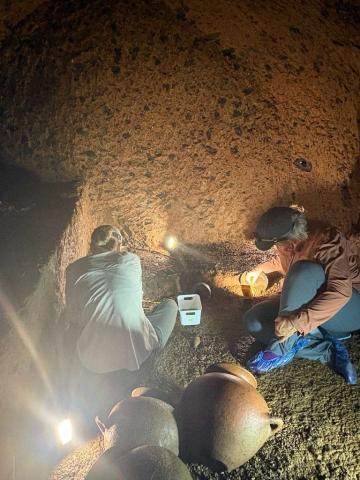
Inside, archaeologists uncovered 13 pottery vessels, including food storage jars, vessels associated with elite wine drinking and a perfume jar. The tomb also contained the skeletal remains of at least two, and possibly three, individuals. Their remains are exceptionally well preserved compared to others previously excavated at the site and offer significant potential for future scientific analyses, including ancient DNA to analyze potential familial relationships and isotopic analysis to discern diet and geographic origins of the people buried in the tomb.
An iron spear point recovered from the burial suggests at least one of the individuals was male, reflecting how masculine status was associated, in part, with weapons of war during this period. Researchers believe the tomb belonged to members of the elite class of the Etruscan settlement that once stood atop the San Giuliano plateau.
Although smaller than the Tomb of the Painted Bird Vases discovered in 2025, researchers say the new find is equally significant because it provides another intact burial from the same period for comparison.
"For me, finding the second intact tomb was as meaningful and exciting as the first," Morrison said. "Finding the tomb untouched with the objects in good condition provides a comparable scale so that we can evaluate each funerary assemblage more thoroughly. Having the two tomb assemblages to examine allows our team to better identify potential vases that were used in daily life and those that might have been placed in the tomb as part of the funerary ritual. That is vital for developing a deeper insight into how people lived and the tools that they used."
A decade of research
Beginning in 2016, SGARP researchers conducted pedestrian surveys of chamber tombs throughout the San Giuliano necropolis before using ground-penetrating radar and ground conductivity surveys to investigate what appeared to be an ancient funerary road leading toward the monumental Tumulus Cuccumella at the center of the Caiolo plateau.
Excavations in 2022 confirmed the presence of the road and uncovered the first of three tumuli that would be investigated over the following seasons. In 2024, the team excavated a chamber tomb that had been looted but yielded important discoveries, including two gold-plated hair spirals. The burial, later named the Tomb of the Golden Spirals (Tomba dei Fermatrecce d'Oro), demonstrated that important archaeological information could still be recovered despite centuries of looting.
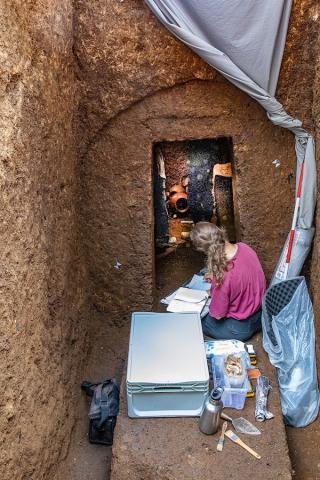
The following summer, researchers uncovered the intact Tomb of the Painted Bird Vases, whose discovery drew international attention and revealed one of the most complete Etruscan funerary assemblages ever found at San Giuliano, with over 100 objects of ceramics, bronze and pasta vitrea (a type of ancient glass).
This year's excavation focused on another tumulus located just south of the Tomb of the Golden Spirals. Before opening the chamber, researchers inserted a small camera to confirm the tomb remained sealed and to prepare for any special conservation needs.
Throughout the excavation, the team documented every stage of the discovery using modern archaeological methods, including total station mapping, three-dimensional scanning, soil sampling, artifact provenience recording and water screening to recover organic materials, and microartifacts and ecofacts.
Understanding a changing Etruscan world
While the newly discovered tomb contained fewer artifacts than the 2025 burial, researchers say the differences are just as important as the similarities.
"Excavation requires patience and perseverance, and we have worked in the Caiolo plateau excavation area for five seasons through long, hot days to uncover many remarkable discoveries, including both the tombs and a funerary road with intact deposits we have barely begun to explore," Aprile said. "Finding a second tomb of the seventh century B.C. will allow us to explore variation within the community as well as the important transitions taking place in Etruscan society as they began to look outward and make contacts with the wider world of the Early Iron Age Mediterranean."
Researchers said the individuals in the newly discovered tomb were buried on a single rock-cut funerary bed. One primary burial was accompanied by a secondary burial in which additional remains had been carefully gathered together and buried positioned alongside the primary individual. An iron pin found beside this burial had textile fragments astonishingly preserved within iron corrosion. The unusual preservation conditions of this textile, which may have been part of a wrapping for the secondary burial or the remnants of clothes, allow the team the opportunity to conduct further studies on Etruscan cloth and weaving techniques.
Research, education and community
Beyond its archaeological discoveries, SGARP continues to serve as one of Baylor's premier international research and study abroad experiences.
Each summer, Baylor students participate in every stage of the archaeological process, from excavation and field documentation to laboratory analysis and conservation. In the SGARP laboratory, students work alongside international specialists to clean, catalog, and study artifacts before they enter permanent collections or ongoing research projects.
"The SGARP Lab functions as the primary processing center for our archaeological investigations," Morrison said. "Students rotate through the facility to master the identification, processing and handling of various artifact types. In addition to fostering student scholarship and interdisciplinary collaboration with international specialists, the lab is deeply engaged with the local community."
That partnership extends beyond the excavation itself. Earlier this summer, artifacts from the 2025 Tomb of the Painted Bird Vases were unveiled in a permanent exhibit at the Museo delle Necropoli Rupestri in Barbarano Romano. Members of the SGARP team designed and installed the exhibition, which welcomed between 250 and 300 visitors and celebrated the region's cultural heritage.
"The energy and excitement surrounding the excavation and the care given to the finds is a continued reminder of how powerful objects are and what they mean to people today and our link to people in the past," Morrison said. "Art, objects and spaces link the past and present, and one of our tasks is to provide context so that accurate stories can be shared."
The discovery demonstrates how years of interdisciplinary collaboration, scientific excavation and international partnership continue to transform understanding of the ancient Etruscan world while providing Baylor students with hands-on research experiences that extend far beyond the classroom.
“Having observed the Zori duo [Drs. Davide and Colleen Zori] and their colleagues at work in Italy, I’m struck by the consummate teacherly presence they offer students at the dig,” Honors College Dean Douglas Henry, Ph.D., said. “Very few undergraduates anywhere receive such immersive experiential learning of the first rank, and even fewer get to be part of pacesetting archaeological discovery.”
ABOUT BAYLOR UNIVERSITY
Baylor University is a private Christian University and a nationally ranked Research 1 institution. The University provides a vibrant campus community for 20,000 students by blending interdisciplinary research with an international reputation for educational excellence and a faculty commitment to teaching and scholarship. Chartered in 1845 by the Republic of Texas through the efforts of Baptist pioneers, Baylor is the oldest continually operating University in Texas. Located in Waco, Baylor welcomes students from all 50 states and more than 100 countries to study a broad range of degrees among its 12 nationally recognized academic divisions. Learn more about Baylor University at www.baylor.edu.
ABOUT THE HONORS COLLEGE AT BAYLOR UNIVERSITY
The Honors College at Baylor University unites five academic pathways: the Bachelor of Philosophy degree, the Great Texts major, the University Scholars major, the Baylor Interdisciplinary Core, and the Honors Program. Students may also choose to live in the Honors Residential College, a multi-year community of students that fosters formation through friendship, study, service, and spiritual engagement. Together these opportunities invite undergraduates to explore questions that reach beyond the boundaries of individual disciplines. For more information, visit the Honors College website.