

Baylor Geosciences Professor Named Fulbright U.S. Scholar
Jay Pulliam, Ph.D., will explore Antarctic ice shelf dynamics and the ancient geological connection between Antarctica and Africa
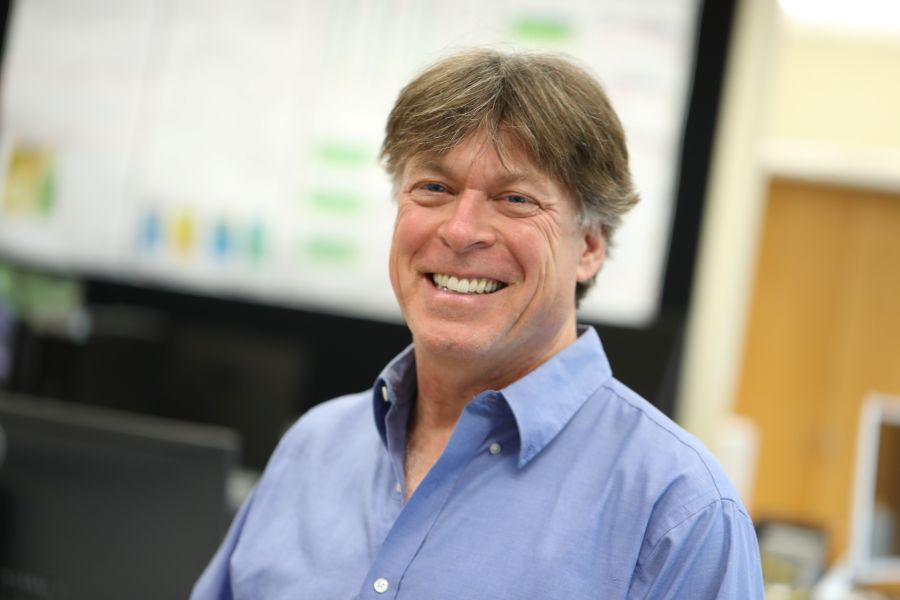
Jay Pulliam, Ph.D., The W.M. Keck Foundation Professor of Geophysics and Fulbright U.S. Scholar (Robert Rogers/Baylor University)
Contact: Kelly Craine, 254-297-9065
Follow us: @BaylorUMedia on X and LinkedIn
Baylor University’s Jay Pulliam, Ph.D., The W.M. Keck Foundation Professor of Geophysics, has been selected as a Fulbright U.S. Scholar, a prestigious fellowship that offer scholars transformative opportunities to teach and conduct research abroad while strengthening their professional development and fostering long‑term connections that enrich their careers, campuses and communities. He is Baylor’s eighth faculty Fulbright recipient since 2022 and the second honoree in 2026.
As a Fulbright U.S. Scholar, Pulliam’s project will leverage an existing, fully funded multinational research initiative in East Antarctica led by faculty at the University of Cape Town to conduct a seismic investigation of the continental margins of Antarctica and South Africa.
“It is an honor to receive this Fulbright award,” Pulliam said. “It will allow me to participate in a major international expedition to Antarctica, focus on research related to that expedition for most of next year and reach a broader group of colleagues and students.”
Pulliam will participate in the annual expedition of the South African Antarctic Programme (SANAP) from December 2026 through February 2027 to collect seismic data in Antarctica. He will then spend the next 10 months in residence in Cape Town, collaborating with faculty and students at UCT and Stellenbosch University.
The project will add an important seismic component to the existing Antarctic study, providing additional insight into the ice dynamics of the Fimbul Ice Shelf. It also will address unresolved questions in plate tectonic models related to the historical connection between Antarctica and southeastern Africa during the Gondwana supercontinent era. The research aims to provide new constraints for numerical modeling of the Fimbul Ice Shelf and integrate geological evidence from both continental margins to better understand their past relationship and points of contact.
Cultural ambassadors
“The Fulbright program also asks its fellows to serve as cultural ambassadors between the host country and the United States to promote mutual understanding and cooperation,” Pulliam said. “It is a great responsibility and an important component of the fellowship, and I look forward to it as well as to the research and teaching.”
During his Fulbright tenure, Pulliam will work closely with students and faculty on the analysis, interpretation and publication of the seismic data while also mentoring students in geophysics and seismology. In addition, he will teach one course each at UCT and Stellenbosch University and deliver lectures on specialized topics, including seismic interferometry, seismic tomography, structural seismology and geophysical inverse methods.
Faculty/Staff Fulbright opportunities
Baylor has a rich tradition of Fulbright scholars. Faculty members from a wide array of disciplines have received Fulbright awards for many years. The Center for Global Engagement welcomes current Baylor faculty and staff members to inform themselves about the Fulbright Scholar Program and consider applying.
ABOUT JAY PULLIAM, PH.D.
Jay Pulliam, The W.M. Keck Foundation Professor of Geophysics and Graduate Program Director in Geosciences, focuses his research on analyzing seismic waves to image Earth’s structure and better understand the processes that shaped the planet into its current state. One common approach in his work involves deploying sensitive seismic instruments to target specific geological features and recording earthquakes and other seismic events over several years. The resulting data can then be analyzed to study earthquake characteristics and develop three-dimensional models of Earth’s interior.
His research group has recently conducted seismic deployments in West Texas and southeastern New Mexico, the Texas and Gulf of Mexico coastal plain, South Texas and the Dominican Republic. These projects broadly examine how additional terranes accreted to and modified Laurentia, the ancient core of North America, as well as the complex plate boundary interactions occurring in the Caribbean region.
Additional current projects include developing an autonomous seismic array for automated processing of ambient noise data for exploration and monitoring applications, along with advancing joint modeling techniques that integrate multiple types of geophysical data.
ABOUT BAYLOR UNIVERSITY
Baylor University is a private Christian University and a nationally ranked Research 1 institution. The University provides a vibrant campus community for 20,000 students by blending interdisciplinary research with an international reputation for educational excellence and a faculty commitment to teaching and scholarship. Chartered in 1845 by the Republic of Texas through the efforts of Baptist pioneers, Baylor is the oldest continually operating University in Texas. Located in Waco, Baylor welcomes students from all 50 states and more than 100 countries to study a broad range of degrees among its 12 nationally recognized academic divisions. Learn more about Baylor University at www.baylor.edu.
ABOUT THE COLLEGE OF ARTS & SCIENCES AT BAYLOR UNIVERSITY
The College of Arts & Sciences is Baylor University’s largest academic division, consisting of 25 academic departments in the sciences, humanities, fine arts and social sciences, as well as 11 academic centers and institutes. The more than 5,000 courses taught in the College span topics from art and theatre to religion, philosophy, sociology and the natural sciences. The College’s undergraduate Unified Core Curriculum, which routinely receives top grades in national assessments, emphasizes a liberal education characterized by critical thinking, communication, civic engagement and Christian commitment. Arts & Sciences faculty conduct research around the world, and research on the undergraduate and graduate level is prevalent throughout all disciplines. Visit the College of Arts & Sciences website.