

Baylor Faculty Celebrate National STEM Day by Bringing Research into Local Classrooms
From magnetic superconductors to DNA repair and pollinator challenges, Baylor researchers help students envision future educational and career pathways in STEM
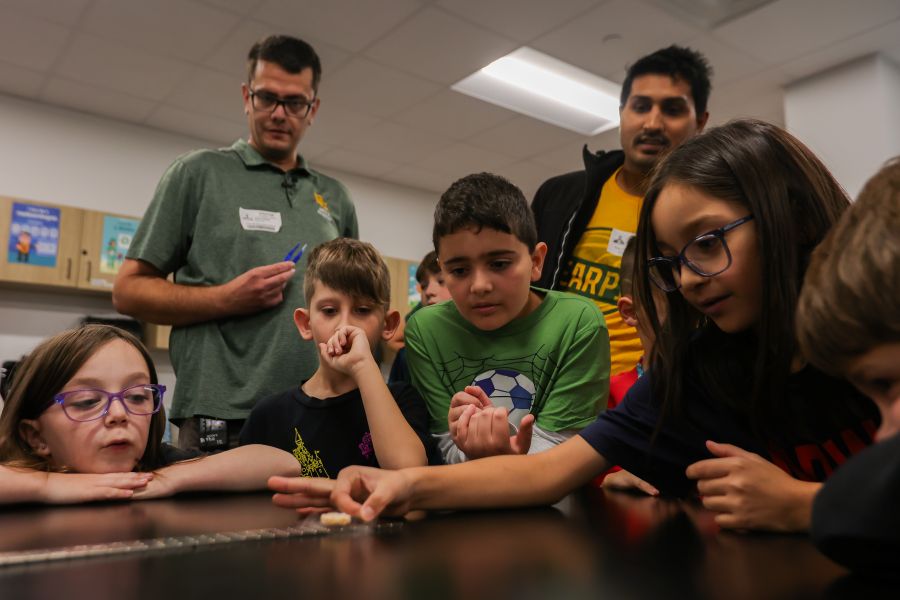
Park Hill Elementary third graders in Midway ISD conduct a magnetism experiment for National STEM Day with Baylor University physics and astronomy professor Alan Farhan, Ph.D. (Hector Gonzalez/Baylor University)
Contact: Kelly Craine, 254-297-9065
Follow us: @BaylorUMedia on X and LinkedIn
For the seventh straight year, Baylor University faculty celebrated National STEM Day by bringing their research into local classrooms. The annual celebration gives Waco-area students the opportunity to meet researchers from their own community and explore science, technology, engineering and math through hands-on activities. For students who may not have envisioned a future in STEM or on a college campus, the STEM Day experience can spark curiosity and help them imagine new pathways for their future.
STEM Day at Baylor is led by the Office of Broader Impacts within Baylor’s Office of the Vice Provost for Research (OVPR), which partners with faculty to tailor each activity to elementary, middle or high school students.
“It is important to encourage the next generation of the STEM workforce, and Baylor University wants to ensure that we’re helping raise up a community of students interested in science, technology, engineering and math,” said Stacey Smith, Ph.D., assistant vice provost for research and research development in OVPR. “We’re excited to connect our tremendous Baylor faculty to serve students and teachers with engaging projects and are grateful for the opportunity to partner with Waco-area schools to make science come alive.”
Students explored magnetism, acted as different pieces of DNA to discover how cells repair DNA and built tools to move mock pollen between flowers. Each activity allowed students to try an idea for themselves and imagine where an interest in STEM might take them, from college to a future career.
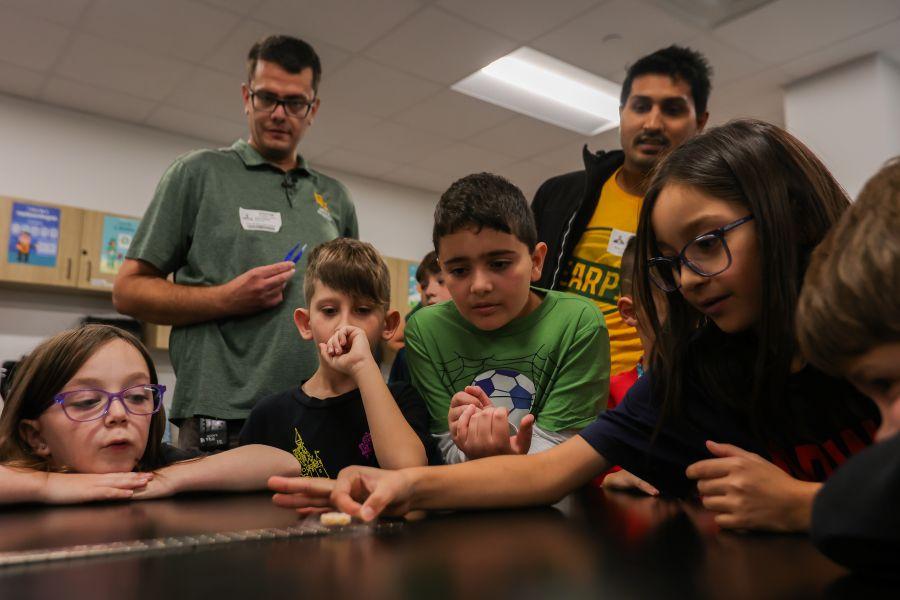
At Park Hill Elementary School in Midway ISD, assistant professor of physics and astronomy Alan Farhan, Ph.D., who studies magnetic materials, had third graders watching in awe as a superconductor hovered above a magnet after it was cooled with liquid nitrogen. The students then built a track from individual magnets and tested whether the superconductor could glide along it.
“So many of the jobs our students may have someday are actually not jobs yet,” said Tammy Mathis, STEM teacher at Park Hill Elementary. “When we have people from Baylor University come, it’s a chance to give students exposure to things they may not be aware of but may be curious about, and it helps them see that a passion they discover now could become a career someday when they’re adults.”
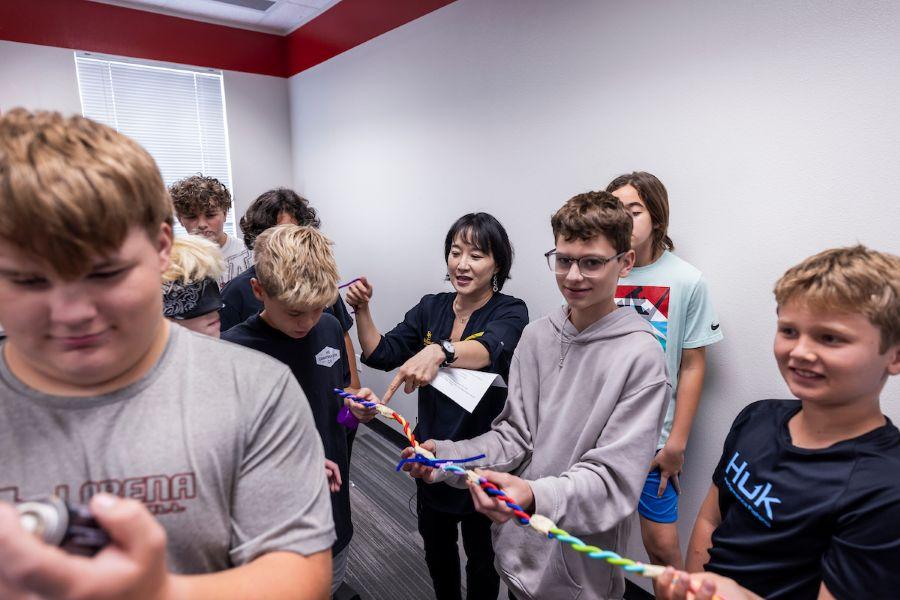
At Lorena Middle School in Lorena ISD, students took on the role of pieces of DNA and worked together to correct errors in a model of the genetic code. Baylor DNA researcher Jung Hyun Min, Ph.D., an associate professor of chemistry and biochemistry, used the activity to show students how cells copy and repair DNA. In her Baylor research lab, Min studies the proteins that help cells detect and mend DNA damage.
“Having an institution like Baylor bring its research directly into our middle school classrooms bridges the gap between foundational learning and real-world impact,” said Samantha Craytor, principal of Lorena Middle School. “When our students interact with university researchers, it unravels higher education and advanced science, showing them that the concepts they study every day have tangible applications right here in our local community.”
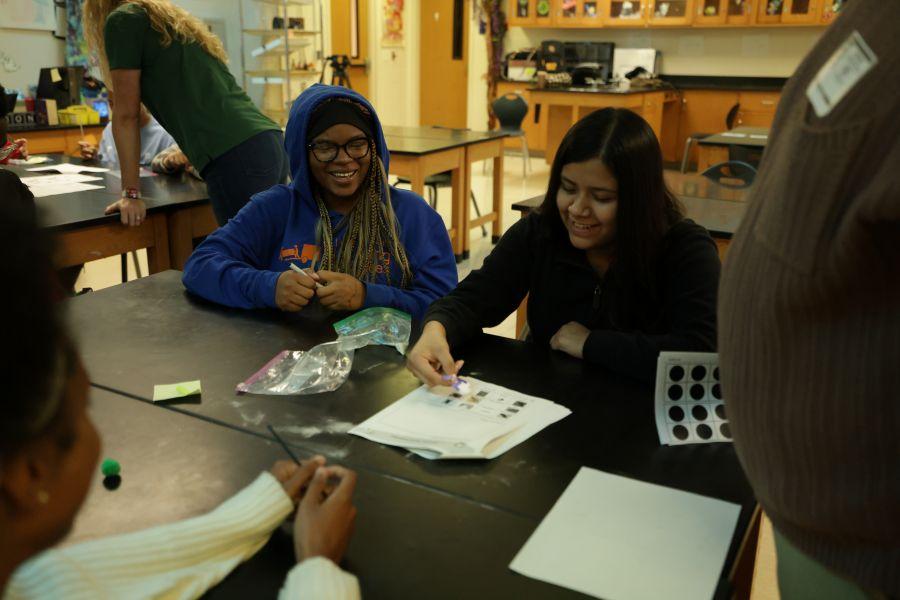
At La Vega High School in La Vega ISD, students designed and built tools to move mock pollen from one flower to another, exploring how people might help pollinate plants in areas with fewer bees. Bree Jimenez, Ph.D., professor and chair of Baylor’s Department of Educational Psychology, led the challenge. Students worked together to test their ideas and used challenges encountered during the process to improve their designs.
“Sharing research locally invites everyone into the conversation, so we can think together about what we want to see for our students, which questions matter most to us and how research can answer those questions and support our community,” Jimenez said. “It also lets students see themselves in the research and imagine the different paths, through their education, careers and community roles, they might take to help answer these questions in the future.”
ABOUT BAYLOR UNIVERSITY
Baylor University is a private Christian University and a nationally ranked Research 1 institution. The University provides a vibrant campus community for nearly 20,000 students by blending interdisciplinary research with an international reputation for educational excellence and a faculty commitment to teaching and scholarship. Chartered in 1845 by the Republic of Texas through the efforts of Baptist pioneers, Baylor is the oldest continually operating University in Texas. Located in Waco, Baylor welcomes students from all 50 states and more than 80 countries to study a broad range of degrees among its 12 nationally recognized academic divisions. Learn more about Baylor University at www.baylor.edu.