

Baylor Engineer Earns Coveted NSF CAREER Award for Elite Early Career Faculty
NSF award allows Clayton Mulvihill, Ph.D., to pursue deeper understanding of how fuels burn in combustion systems, providing tools for cleaner, more efficient engines
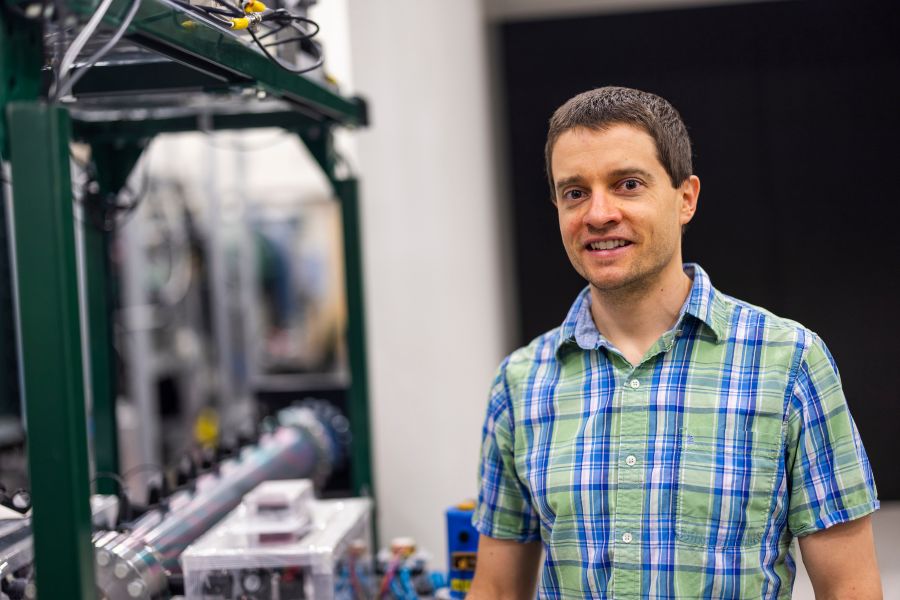
Assistant Professor of Mechanical Engineering Clayton R. Mulvihill, Ph.D., has earned one of the National Science Foundation's most prestigious awards in support of early-career faculty. (Matthew Minard/Baylor University)
Contact: Lori Fogleman, 254-709-5959
Follow us: @BaylorUMedia on X and LinkedIn
Clayton R. Mulvihill, Ph.D., assistant professor of mechanical engineering at Baylor University’s School of Engineering and Computer Science, has earned a coveted Early Career Development Award (CAREER) from the National Science Foundation (NSF) to develop deeper understanding of the chemical behavior of common atoms found in most combustion systems. His research providing more detailed insights into the fundamental reactions that take place when hydrogen, nitrogen and oxygen burn would offer new tools for engineers to develop cleaner and more efficient engines.
“I was very thankful to learn I received the CAREER Award from National Science Foundation,” Mulvihill said, “and grateful for the chance to combine experimental and theoretical research through a grant that provides stability for this work as an early career researcher.”
The NSF describes the CAREER program and its recipients as the “National Science Foundation's most prestigious awards in support of early-career faculty who have the potential to serve as academic role models in research and education and to lead advances in the mission of their department or organization.” The commensurate funding with the award will be nearly $600,000 over five years to support Mulvihill’s work.
“Dr. Mulvihill is one of our impressive junior faculty members here at Baylor, and I’m so pleased to see him progress so rapidly in reaching his research milestones,” said Daniel Pack, Ph.D., dean of the School of Engineering and Computer Science. “The NSF CAREER Award is no small achievement and worth serious attention. I look forward to celebrating many more of Dr. Mulvihill’s successes in the years to come.”
Building blocks of combustion
Hydrogen, nitrogen and oxygen are present in nearly all combustion processes, from car engines to jet turbines and power plants. Despite their prevalence, many of the individual reaction steps governing how these gases interact are not fully understood.
To address this, Mulvihill combines laboratory experiments with theoretical modeling to measure and predict how fast these reactions occur under different temperatures and pressures.
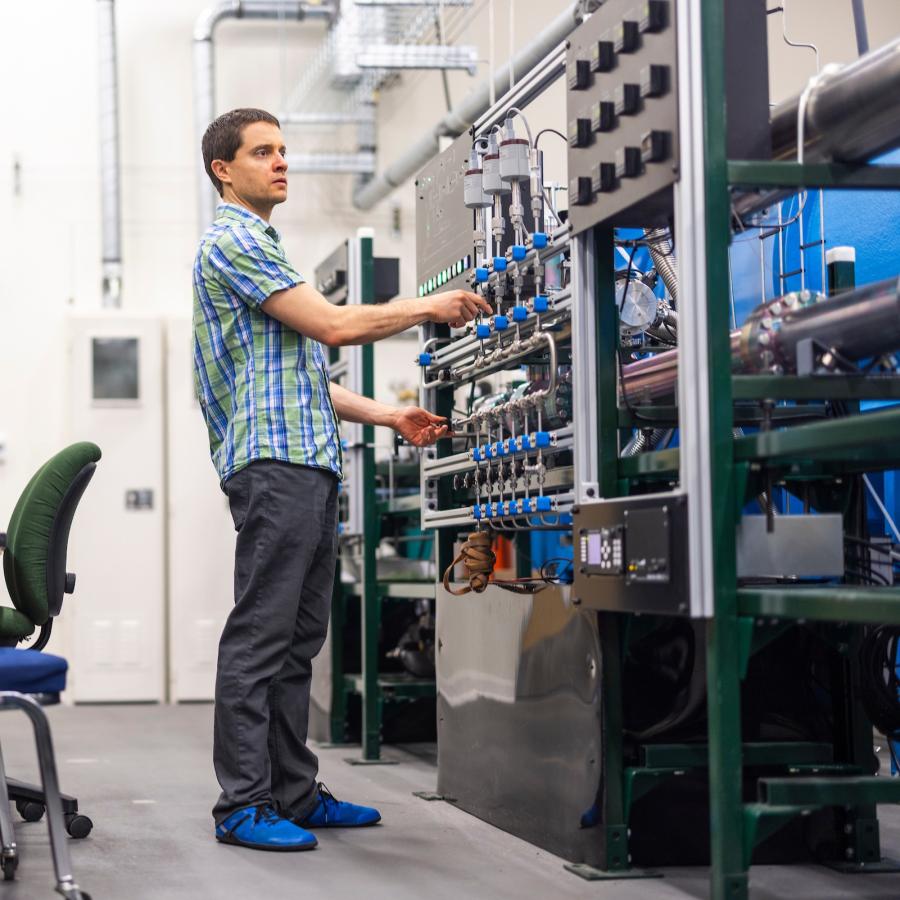
Inside his Reaction Kinetics Lab in the Baylor Research and Innovation Collaborative (BRIC), Mulvihill recreates and measures the extreme conditions found inside engines using specialized equipment like shock tubes and lasers. The shock tubes allow him to rapidly heat and compress gases in microseconds. He then uses advanced laser-based diagnostics to observe the reactions as they happen in real time.
“These reactions happen incredibly fast and can be difficult to capture,” Mulvihill said. “By using lasers, we can essentially ‘see’ what’s going on and get precise measurements that are challenging with other techniques.”
At the same time, he uses computational models to simulate the same processes, allowing him to compare predictions with experimental results and refine both. At the end of the five-year grant period, Mulvihill hopes to have delivered more accurate rate constants within chemical reactions, providing researchers with new building blocks to use and reinterpret in the future. Additionally, Mulvihill and his team aim to develop a laser diagnostic for nitrous acid – a species never-before measured in a shock tube.
Drawn by the intersection of faith and research
Mulvihill joined the Baylor faculty in 2023 after serving as a postdoctoral researcher at Argonne National Laboratory in Illinois. A native Texan, he was drawn to Baylor for the opportunity to return to his home state and join a Christian R1 university.
“At Baylor, I can freely incorporate my faith into how I teach,” Mulvihill said, “and the BRIC itself is an amazing facility. The resources I have in this lab were critical in helping to earn this award. It was not hard to make a convincing argument that I could do the things I aimed to do with the resources I’ve been provided.”
ABOUT BAYLOR UNIVERSITY
Baylor University is a private Christian University and a nationally ranked Research 1 institution. The University provides a vibrant campus community for 20,000 students by blending interdisciplinary research with an international reputation for educational excellence and a faculty commitment to teaching and scholarship. Chartered in 1845 by the Republic of Texas through the efforts of Baptist pioneers, Baylor is the oldest continually operating University in Texas. Located in Waco, Baylor welcomes students from all 50 states and more than 100 countries to study a broad range of degrees among its 12 nationally recognized academic divisions.
ABOUT THE SCHOOL OF ENGINEERING AND COMPUTER SCIENCE AT BAYLOR UNIVERSITY
Baylor ECS is advancing as a premier School of Engineering and Computer Science in research and education with a commitment to Christian values. Majors include aerospace engineering, bioinformatics, computer science, data science, cybersecurity, computer engineering, electrical and computer engineering, general engineering and mechanical engineering. ECS offers a number of graduate and Ph.D. programs, such as biomedical engineering, online computer science and interdisciplinary degrees in Materials Science and Engineering. The School also offers graduate professional certificates. ECS stands out from the crowd through Christian commitment, R1 research, a caring community, personalized career support, expert faculty and leading practical experience. Visit the ECS website to learn more and follow on Instagram and Facebook.