

Baylor Astrophysicist Helps Prepare NASA’s Roman Space Telescope for Launch
Benjamin Rose, Ph.D., will help NASA process unprecedented amounts of data as Roman searches for clues about dark energy, black holes and the evolution of the universe
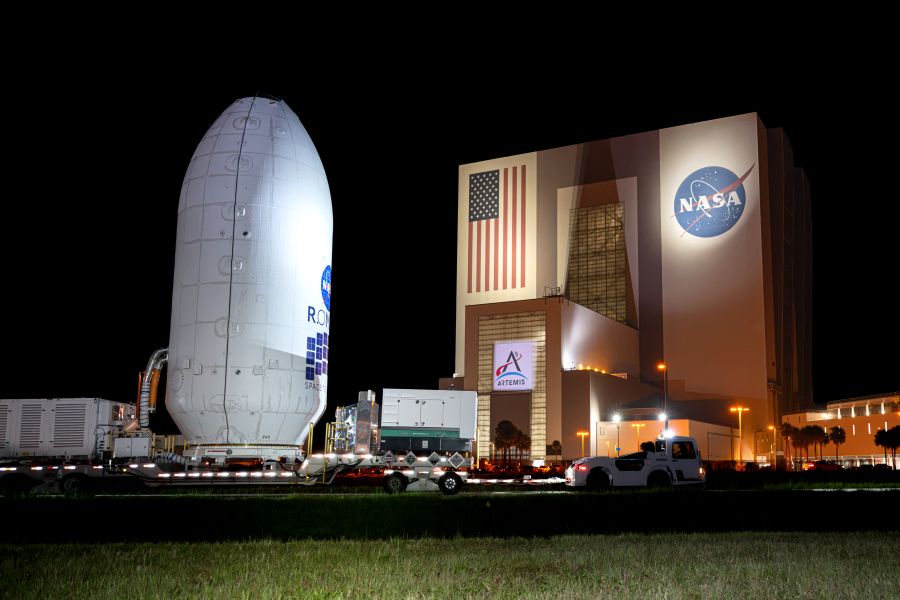
NASA’s Nancy Grace Roman Space Telescope, encapsulated in its payload fairing, travels from the Payload Hazardous Servicing Facility to the SpaceX hangar at Launch Complex 39A at NASA’s Kennedy Space Center on Tuesday, Aug. 25, 2026, ahead of mating to a SpaceX Falcon Heavy rocket. (Photo courtesy of NASA / Photographer: Sydney Rohde (Rocz) )
Contact: Kelly Craine, 254-297-9065
Follow us: @BaylorUMedia on X and LinkedIn
When NASA’s Nancy Grace Roman Space Telescope launches this Sunday, Aug. 30, Baylor University astrophysicist Benjamin Rose, Ph.D., will be there to witness history, as years of preparation begin a new chapter – and open a wider window into the universe.
Roman is scheduled to lift off at 7:26 a.m. EDT aboard a SpaceX Falcon Heavy rocket from Launch Complex 39A at NASA’s Kennedy Space Center in Florida.
Named for NASA’s first chief astronomer and a driving force behind the Hubble Space Telescope, Roman is designed to explore some of astronomy’s largest unanswered questions. It will investigate dark energy and dark matter, search for planets beyond the solar system and study how galaxies, stars and black holes have changed across cosmic time.
“We’re really going to change the way that astronomy is done with Roman.” - Benjamin Rose, Ph.D., assistant professor of physics at Baylor
Rose, assistant professor of physics at Baylor, is among the scientists helping NASA prepare for the enormous volume of information Roman will send back to Earth. He is one of four leaders of a NASA-funded project infrastructure team developing the data-analysis pipeline for Roman’s supernova cosmology research.
“The Roman telescope has the same depth and spatial resolution as Hubble, but can survey the sky at 1,000 times the rate of speed. So, something that would take 1,000 months in the past would now require just one month of Roman operation,” Rose said. “Its field of view is over 100 times that of Hubble and, unlike past projects, can operate continuously for constant observance.”
That speed will allow Roman to discover cosmic events on a scale astronomers have never experienced, but it also creates a significant challenge.
Roman is expected to produce a 20-petabyte archive during its five-year primary mission, Rose said. That volume of information cannot simply be downloaded to a researcher’s laptop or even easily transferred to a university computing system. Instead, scientists will bring their analyses to the cloud-based data and work within a shared software environment.
“We’re really going to change the way that astronomy is done with Roman,” Rose said.
The search for exploding stars
Rose and his collaborators are preparing the infrastructure needed to identify, calibrate and organize transient objects, which are phenomena that appear, brighten, fade or change over time. The team’s primary focus is Type Ia supernovae, exploding stars whose predictable brightness allows astronomers to measure distances across the universe.
By comparing those distances with how quickly galaxies are moving away, scientists can trace the expansion of the universe and study dark energy, the mysterious force driving that expansion to accelerate. Roman is expected to improve measurements of dark energy and give scientists a clearer picture of how its influence may have changed over billions of years.
Roman’s sweeping view also will reveal many other short-lived cosmic events. Those could include tidal disruption events, which occur when a star passes too close to a supermassive black hole and is torn apart by its immense gravity. As the stellar debris spirals toward the black hole, it heats up and produces a flare bright enough to be seen across enormous distances.
The mission also is expected to identify thousands of planets outside the solar system, including free-floating worlds that do not orbit a star. Together, these discoveries will help researchers examine questions ranging from planetary formation to the structure and history of the universe.
Discoveries ahead
For Rose, Roman’s greatest promise may lie not only in the questions it was designed to answer, but also in the discoveries no one has anticipated. Its panoramic view, repeated observations and vast public archive will give astronomers opportunities to find rare objects and unexpected phenomena for years to come.
As Roman begins its journey, Baylor space research will help ensure that scientists around the world can turn that unprecedented stream of data into a deeper understanding of the cosmos.
ABOUT BAYLOR UNIVERSITY
Baylor University is a private Christian University and a nationally ranked Research 1 institution. The University provides a vibrant campus community for 20,000 students by blending interdisciplinary research with an international reputation for educational excellence and a faculty commitment to teaching and scholarship. Chartered in 1845 by the Republic of Texas through the efforts of Baptist pioneers, Baylor is the oldest continually operating University in Texas. Located in Waco, Baylor welcomes students from all 50 states and more than 100 countries to study a broad range of degrees among its 12 nationally recognized academic divisions. Learn more about Baylor University at www.baylor.edu.
ABOUT THE COLLEGE OF ARTS & SCIENCES AT BAYLOR UNIVERSITY
The College of Arts & Sciences is Baylor University’s largest academic division, consisting of the School of Earth and Environmental Sciences and 24 academic departments in the sciences, humanities, fine arts and social sciences, as well as 12 academic centers and institutes. The more than 5,000 courses taught in the College span topics from art and theatre to religion, philosophy, sociology and the natural sciences. The College’s undergraduate Unified Core Curriculum, which routinely receives top grades in national assessments, emphasizes a liberal education characterized by critical thinking, communication, civic engagement and Christian commitment. Arts & Sciences faculty conduct research around the world, and research on the undergraduate and graduate level is prevalent throughout all disciplines. Visit the College of Arts & Sciences website.