

5 Reasons to Put Seasonal Produce on Your Plate
Baylor nutrition expert shares how eating seasonally can support wellness during the holidays and beyond
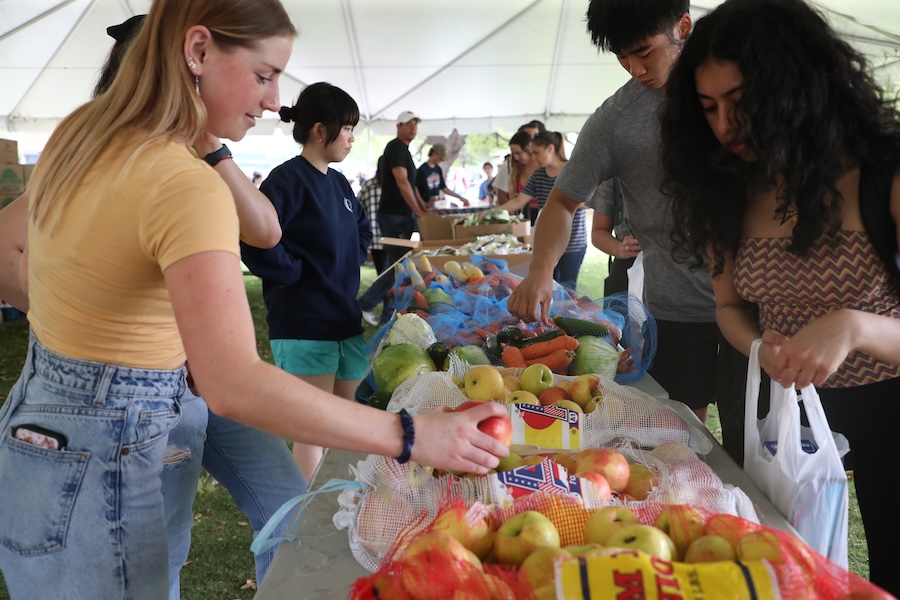
The Baylor Free Farmers Market is held once each semester to provide students with free access to fresh fruits and vegetables, while also raising awareness about food insecurity on college campuses. (Baylor Photography)
Contact: Shelby Cefaratti-Bertin, 254-327-8012
Follow us: @BaylorUMedia on X and LinkedIn
As temperatures begin to drop, grocery stores trade summer berries and watermelon for apples, squash and pumpkins. While these seasonal changes may seem like little more than a shift in fall flavors, the foods we choose throughout the year can influence our nutrition, grocery bills and eating habits. But is eating with the seasons actually better for us, or is it simply another wellness trend?

Robbins College of Health and Human Sciences
According to LesLee Funderburk, Ph.D., associate professor of nutrition sciences at Baylor University, eating seasonally offers a variety of benefits, especially during the holiday season when healthy habits can be more difficult to maintain.
“The holiday season is a great time to improve or maintain fruit and vegetable intake to support overall wellness,” Funderburk said.
From improving nutrient intake to supporting local growers, here are five reasons why Funderburk recommends choosing seasonal produce.
5 top reasons to eat seasonally
1. Increased quality of produce
At almost any time of year, consumers can walk into a supermarket and find strawberries, blueberries and other produce that may not be in season locally. Modern agriculture and transportation make it possible to ship produce from other regions or grow it in controlled environments, making many fruits and vegetables available year-round.
Eating produce in season allows consumers to enjoy fruits and vegetables at their peak flavor, freshness and nutritional value.
“In-season fruit and vegetables are allowed to ripen naturally, which improves nutrient density, inclusive of vitamins, minerals and phytonutrients,” Funderburk said. “Consumers also may notice better taste and texture in fresh seasonal produce, particularly when compared with some canned and frozen alternatives.”
2. Eating a well-rounded diet
Another benefit of eating seasonally is that it naturally encourages variety. As different fruits and vegetables come into season throughout the year, consumers can expand their diets beyond a handful of similar foods.
“The rotating cycle of seasonal foods encourages a more varied diet, allowing consumers to incorporate different nutrients throughout the year,” Funderburk said. “As we vary our consumption seasonally of these food items, we are improving the diversity of consumption of key nutrients, which all lends to improved overall health.”
3. Balancing holiday calories
The holiday season is often filled with sweet treats and calorie-dense foods. Adding fruits and vegetables, which are typically less calorie-dense than holiday desserts or other season treats, can help maintain balanc throughout the season.
“This can help offset overconsumption of readily available items such as holiday cookies and other sweets, which generally are more calorie-dense due to the amount of sugar and fat that they contain,” Funderburk said. “The calorie density is what can add up and promote unwanted holiday weight gain of an estimated average of 1-2 pounds.”
4. Adding fiber to your diet
Seasonal fruits and vegetables offer more than just vitamins and minerals. They are also important sources of dietary fiber, which supports digestive health.
“The other benefit of variety is the consumption of soluble and insoluble fiber, which supports gut health,” Funderburk said. “Adults should aim for about 25-35 grams of fiber per day.”
Adding two to three servings of vegetables each day can help boost fiber intake and move you closer to that daily goal.
5. Supporting local growers
Beyond taste and nutrition, eating seasonally provides an opportunity to support local farmers and growers.
“Supporting local growers is always a positive thing regarding the promotion of and support for our local economy and community members,” Funderburk said. “Buying local can positively impact fuel use or fuel savings, both for growers and consumers.”
Shopping at farmers' markets or choosing locally grown produce can support small businesses and local food systems while connecting consumers with the people who grow their food.
Whether the goal is making healthier choices or supporting local growers, Funderburk says eating seasonally is a simple way to support overall wellness throughout the year.
ABOUT BAYLOR UNIVERSITY
Baylor University is a private Christian University and a nationally ranked Research 1 institution. The University provides a vibrant campus community for 20,000 students by blending interdisciplinary research with an international reputation for educational excellence and a faculty commitment to teaching and scholarship. Chartered in 1845 by the Republic of Texas through the efforts of Baptist pioneers, Baylor is the oldest continually operating University in Texas. Located in Waco, Baylor welcomes students from all 50 states and more than 100 countries to study a broad range of degrees among its 12 nationally recognized academic divisions. Learn more about Baylor University at www.baylor.edu.
ABOUT ROBBINS COLLEGE OF HEALTH AND HUMAN SCIENCES AT BAYLOR UNIVERSITY
Established in 2014, Robbins College of Health and Human Sciences seeks to enhance health, quality of life and human flourishing for all individuals and communities through education, research and innovation. It includes six academic departments – Communication Sciences and Disorders; Health, Human Performance, and Recreation; Human Sciences and Design; Occupational Therapy; Physical Therapy; and Public Health – along with the Division of Health Professions, which houses the Master of Physician Assistant Studies program. Robbins College offers 13 bachelor’s degrees, 10 master’s degrees and six doctoral degrees, as well as nine graduate programs in partnership with the U.S. Army. Graduate programs in Robbins College are offered in a variety of modalities, including on campus, online and hybrid. For more information, visit the Robbins College website.