

NASA’s Roman Space Telescope Simulation Previews Breakthrough Discoveries of Cosmic Events
Baylor astrophysicist leads “Hourglass Simulation,” previewing the detection of 100,000 celestial blasts, ranging from exploding stars to feeding black holes
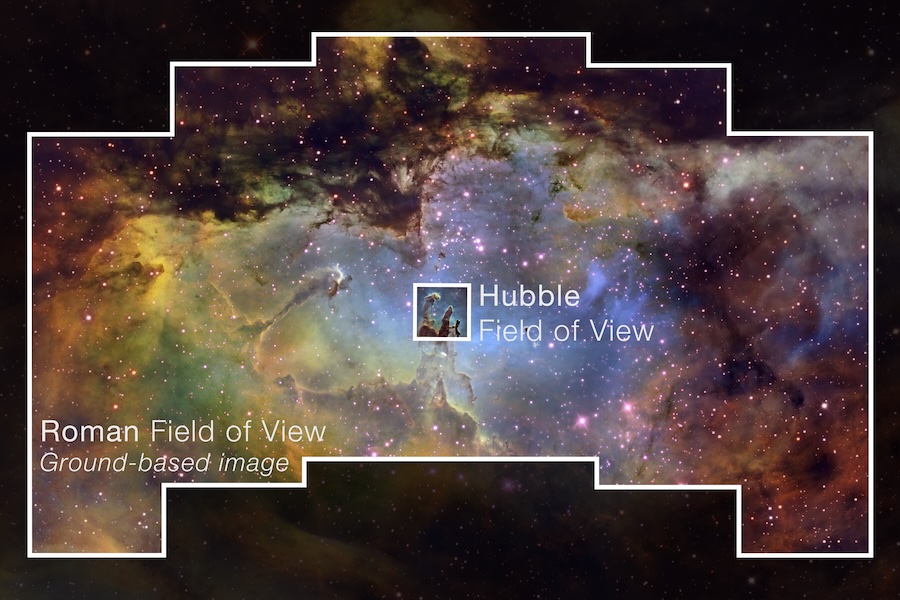
This image of the Eagle Nebula showcases the superb resolution and wide field of view of NASA’s upcoming Nancy Grace Roman Space Telescope. In the center is Hubble's view of the Pillars of Creation - superimposed on a ground-based image. Roman’s Wide Field Instrument field of view is highlighted. Roman’s images will have the resolution of Hubble while covering an area about 100 times larger in a single pointing. (Credit: T.A.Rector (NRAO/AUI/NSF and NOIRLab/NSF/AURA) and B.A.Wolpa (NOIRLab/NSF/AURA)) and an image by amateur astronomer Liam Murphy.
Contact: Shelby Cefaratti-Bertin, 254-327-8012
Follow us: @BaylorUMedia on X and LinkedIn

A team of astrophysicists led by Benjamin Rose, Ph.D., assistant professor of physics and astronomy at Baylor University, has released a powerful new simulation previewing the extraordinary discoveries expected from the Nancy Grace Roman Telescope, NASA’s next large flagship mission. In their article – “The Hourglass Simulation: A Catalog for the Roman High-latitude Time-domain Core Community Survey” – published in The Astrophysical Journal, Rose and his fellow researchers revealed how the simulation demonstrates Roman’s potential to detect and classify cosmic transients across deep space by observing tens of thousands of cosmic events – serving as a critical tool for astronomers.
Set to launch in October 2026, Roman is expected to reshape the understanding of the cosmos, dark energy and the life cycles of stars. In just over two years, researchers anticipate the most in-depth, detailed understanding of deep space ever achieved.
To showcase Roman’s capabilities, the team released data on 10 different transients, including both imaging and spectroscopy. By creating simulated catalogs, scientists can evaluate the usefulness of the data, refine their methodologies and prepare for the actual survey before Roman’s launch.
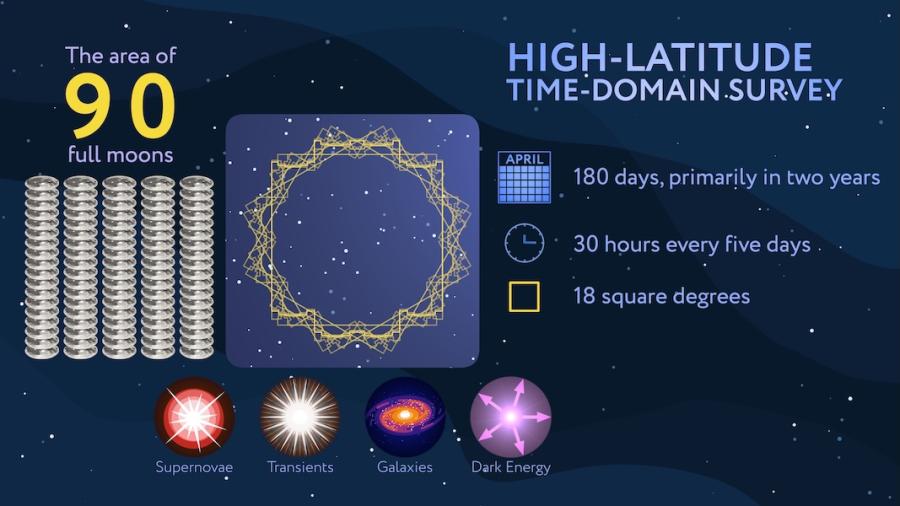
“This survey will look at the same patch of the night sky about every five days for two years to see what's changing,” Rose said. “We can use the information gained for lots of different science cases, one of which is trying to measure distances to these objects and understand the universe in three dimensions.”
Rose joined Baylor University in fall 2023 and serves as one of the four co-principal investigators on a supernova project infrastructure team, which received $11 million in funding through a five-year cooperative agreement with NASA.
Power of the Roman Space Telescope
While the Hubble Space Telescope and the James Webb Space Telescope have significantly expanded the understanding of the cosmos, Roman will dramatically enhance NASA’s data-gathering capabilities. Leveraging decades of technological advances, Roman will increase both the scope and speed of data collection. Compared to Hubble, Roman can observe the night sky roughly 1,000 times faster, offering a much deeper understanding of the universe.
“The fact is, we can ask questions that we just weren't able to ask with Hubble,” Rose said. “Hubble has a huge, amazing archive, but compared to Roman, it's incredibly limited.”
Unprecedented discovery volume
Rose and team predict that Roman will detect over 64,000 transient objects over a two-year period, including:
- approximately 21,000 Type Ia supernovae,
- 40,000 core-collapse supernovae,
- approximately 70 superluminous supernovae,
- ∼35 tidal disruption events,
- three kilonovae,
- and possibly pair-instability supernovae.
This marks a dramatic leap in time-domain astronomy, enabling new insights into stellar life cycles and the expansion of the universe, Rose said.
“What's exciting about Roman is the data volume,” Rose said. “In a total of six months of Roman time observation, we will collect the equivalent of the entire 30 years of Hubble’s data.”
Type Ia supernovae
Roman’s ability to record a significantly wider region of the sky allows for deeper study of transient phenomena like supernovae – specifically Type Ia, which are key to measuring the expansion of the universe. This capability not only helps answer long-standing questions in astrophysics but also opens the door to entirely new lines of inquiry in cosmology.
“We've been looking at the same sort of cosmological parameters, nailing them down and getting a better understanding of them,” Rose said. “But with Roman and its generational leap and ability to observe hundreds of times more objects, we can start asking new questions which help us understand the life cycle of the universe.”
Crucial preview
As Roman’s launch approaches, Rose and his team’s Hourglass Simulation provides a crucial preview of the telescope’s unprecedented potential. By modeling tens of thousands of cosmic events, the simulation equips astronomers with the tools and foresight needed to maximize the Roman’s impact from day one.
“Whether you want to explore dark energy, dying stars, galactic powerhouses or probably even entirely new things we’ve never seen before, this survey will be a gold mine.” - Benjamin Rose, Ph.D.
“Whether you want to explore dark energy, dying stars, galactic powerhouses or probably even entirely new things we’ve never seen before, this survey will be a gold mine,” Rose said.
The Roman mission promises to transform our understanding of the universe – revealing its structure, evolution and mysteries with extraordinary clarity and scope.
FUNDING
Funding for the Roman Supernova Project Infrastructure Team has been provided by NASA under contract 80NSSC24M0023
ABOUT BENJAMIN ROSE, PH.D.
Benjamin Rose, Ph.D., is an assistant professor of physics at Baylor University. He researches deep space transients, including Type Ia supernovae, observational cosmology, absolute and relative calibration of telescopes, space telescope missions and large computational analysis. In 2018, he received his doctorate from the University of Notre Dame, where his dissertation focused on systematic biases of Type Ia supernova distances used in observational cosmology. He has worked as a member of the Roman Space Telescope's supernova science investigation team for almost a decade.
Rose joined Baylor University in 2023 and was named as one of four co-principal investigators for the Project Infrastructure Team (PIT). The team is working with NASA through an $11 million cooperative agreement, which funds research to investigate infrastructure solutions for the Nancy Grace Roman Telescope. He works alongside Dan Scolnic, Ph.D., of Duke University; Rebekah Hounsell, Ph.D., of the University of Maryland-Baltimore County and NASA’s Goddard Space Flight Center; and David Rubin, Ph.D., of the University of Hawaii, and a team of more than 50 scientists from over a dozen universities.
ABOUT BAYLOR UNIVERSITY
Baylor University is a private Christian University and a nationally ranked Research 1 institution. The University provides a vibrant campus community for more than 20,000 students by blending interdisciplinary research with an international reputation for educational excellence and a faculty commitment to teaching and scholarship. Chartered in 1845 by the Republic of Texas through the efforts of Baptist pioneers, Baylor is the oldest continually operating University in Texas. Located in Waco, Baylor welcomes students from all 50 states and more than 100 countries to study a broad range of degrees among its 12 nationally recognized academic divisions. Learn more about Baylor University at www.baylor.edu.
ABOUT THE COLLEGE OF ARTS & SCIENCES AT BAYLOR UNIVERSITY
The College of Arts & Sciences is Baylor University’s largest academic division, consisting of 25 academic departments in the sciences, humanities, fine arts and social sciences, as well as 11 academic centers and institutes. The more than 5,000 courses taught in the College span topics from art and theatre to religion, philosophy, sociology and the natural sciences. The College’s undergraduate Unified Core Curriculum, which routinely receives top grades in national assessments, emphasizes a liberal education characterized by critical thinking, communication, civic engagement and Christian commitment. Arts & Sciences faculty conduct research around the world, and research on the undergraduate and graduate level is prevalent throughout all disciplines. Visit the College of Arts & Sciences website.