

Baylor Hosts Mathematics for Early Learners Academy Throughout July
Summer math program establishes solid foundation in “number sense” for early learners
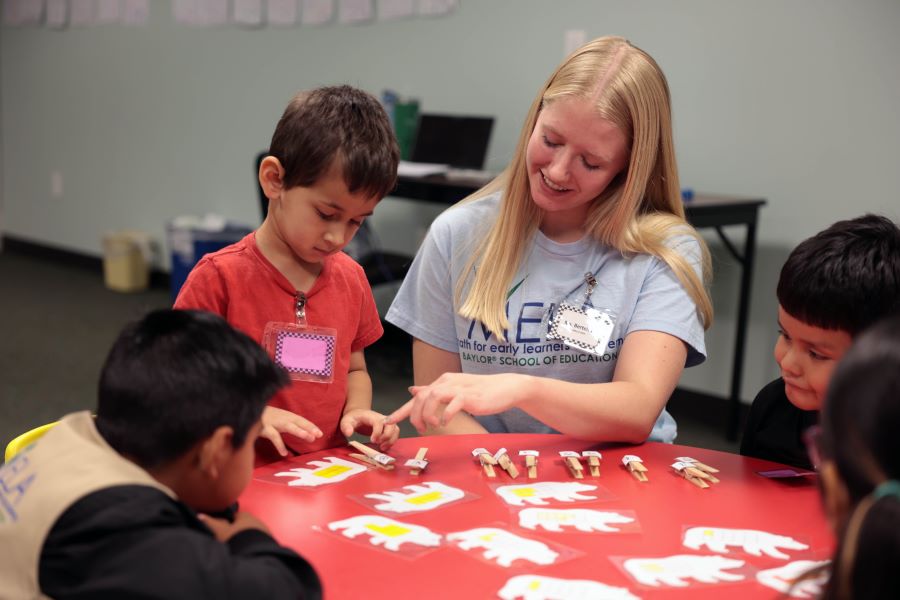
School of Education master’s candidate Sarah Bertelson, B.S.Ed. '24, instructs students from Bell’s Hill Elementary in Waco ISD in early math concepts at the Math for Early Learners Academy. Bertelson will teach at Bell’s Hill after her August graduation. (Photo by Gaby Garcia)
Contact: Baylor University Media & Public Relations, 254-710-1961
Follow us: @BaylorUMedia on X and LinkedIn
Baylor University’s Mathematics for Early Learners Academy (MELA), sponsored by the Baylor School of Education (SOE), is underway now at the Mayborn Museum on the Baylor campus through July 24 for students ages 4 to 6.
The four-week summer program, designed for students who have just finished PreK or Kindergarten and directed by Sandi Cooper, Ph.D., professor of mathematics education, aims to establish a solid foundation in “number sense,” especially for students who could benefit most from this summer experience in mathematics.
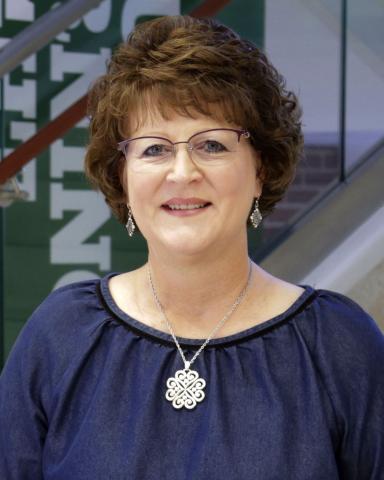
According to Cooper, research shows early math skills are a better predictor of academic success than reading skills. However, many preschools don’t focus enough on math, and students often don’t receive interventions in math until later grades.
The program, which has measurably helped young students achieve or exceed grade-level expectations in early math skills and number fluency, continues to test its new curriculum and assessments and conduct new research related to the development of early numeracy in an informal learning environment.
“MELA is all about gaining number sense, which is composing and decomposing numbers – more than just counting,” Cooper said. “When you think about the number 5, you can see it as a sum of 3 and 2 or of 4 and 1, and there are sets of five and counting by fives. And 5 can be found in the real world; for example, a nickel represents the number 5. It’s about understanding what numbers mean, not just rote counting.”
For 2025, Baylor SOE is partnering with three school districts and hosting more than 80 students from five different elementary schools:
- Waco ISD – Dean Highland Elementary, Crestview Elementary and Bell’s Hill Elementary
- La Vega ISD – La Vega Primary
- Midway ISD – Castleman Creek Elementary and Hewitt Elementary
MELA staff includes eight master teachers, five Baylor students, eight paraprofessionals from participating ISDs, five graduate students (from two Baylor departments) and one research consultant (a recent Baylor doctoral graduate).
Faculty includes Cooper; SOE clinical assistant professor Tracey Jones, Ph.D., providing English as a Second Language (ESL)/bilingual support; and clinical assistant professor Mandy Dunphy, Ph.D., who is leading the MELA research team.
Baylor campus advantage
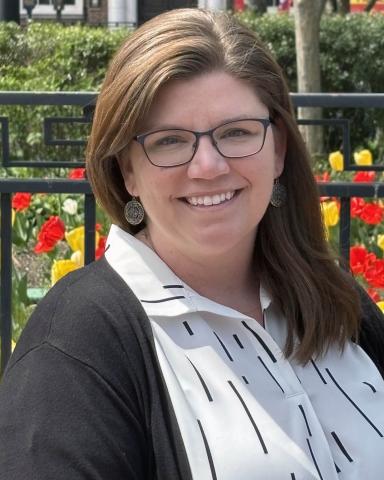
Cooper said the MELA experience is enhanced by being on the Baylor campus, based at the Mayborn Museum. Since the launch of MELA in 2016, Cooper and her team have taken advantage of the informal learning experiences that the Mayborn Museum offers.
While MELA does include classroom time, it supports that learning through interactive, play-based experiences that are often absent in formal education settings. The exploratory play and hands-on activities of Mayborn exhibits promote essential math skills and early numeracy development.
During daily museum walks, teachers connect exhibits to the math skills the students are learning. For example, the Mayborn’s Play Waco area includes a grocery store, where students can count and categorize the products and produce, count and compare totals, find patterns in products lining the shelves, and more.
MELA students also engage in STEM-focused activities. Led by Alan Small, STEM specialist at the Mayborn, the students are exploring topics including insects, magnets and fossils. Each week, the STEM exploration integrates number sense through the museum exhibits and special activities. When learning about insects, students explore with real meal worms, counting the total in their bin to compare with other bins. These live insects help them learn — in a memorable way — about the number of legs that insects have to distinguish the difference from other critters.
Other Baylor field trips also offer math in an informal setting. MELA students spend a morning in a Baylor athletic facility, meeting university athletes from different sports. Children rotate to stations to play physical games with the athletes that include number sense.
Children also visit Baylor’s Bill and Eva Williams Bear Habitat, an on-campus zoo accredited by the Association of Zoos and Aquariums. MELA students see the bears, engage with the bear trainers, and learn about bear diets, exercise, and the life of a mascot.
“By hosting all children at the Mayborn, we are able to offer more instructional time devoted to the concepts presented in the newly developed MELA curriculum,” Cooper said. “At the Mayborn, MELA is from 9 a.m. to noon, and the entire time is focused on math. The instructional time includes whole-group lessons, small-group lessons, stations and museum walks focused on number develop development.”
This summer MELA’s theme is “Counting with Cats and Dogs,” to coordinate with the traveling exhibit at the Mayborn.
New research focused on informal learning
Cooper and her School of Education team of faculty, graduate students, and teacher-education students are collecting new data this summer to study how informal STEM learning experiences can foster number sense for early learners.
To see MELA through the eyes of the children themselves, researchers are outfitting a few students each day with a small GoPro camera. This will give them a chance to observe what the students notice, focus on, and get excited about during their learning adventures.
Research team leader Dunphy said, “It’s one thing to plan a lesson, but it’s another to see what really sparks a child’s curiosity. These videos will help us understand how kids naturally connect with math in playful, everyday moments.”
ABOUT BAYLOR UNIVERSITY
Baylor University is a private Christian University and a nationally ranked Research 1 institution. The University provides a vibrant campus community for more than 20,000 students by blending interdisciplinary research with an international reputation for educational excellence and a faculty commitment to teaching and scholarship. Chartered in 1845 by the Republic of Texas through the efforts of Baptist pioneers, Baylor is the oldest continually operating University in Texas. Located in Waco, Baylor welcomes students from all 50 states and more than 100 countries to study a broad range of degrees among its 12 nationally recognized academic divisions. Learn more about Baylor University at www.baylor.edu.
ABOUT BAYLOR SCHOOL OF EDUCATION
For more than 100 years, the School of Education has advanced Baylor’s mission across the globe while preparing students for a range of careers focused on education, leadership, and human development. With more than 60 full-time faculty members, the school’s growing research portfolio complements its long-standing commitment to excellence in teaching and student mentoring. Baylor’s undergraduate program in teacher education has earned national distinction for innovative partnerships with local schools that provide future teachers deep clinical preparation. Likewise, the School of Education’s graduate programs have attained national recognition for their exemplary preparation of research scholars, educational leaders, innovators, and clinicians. Visit the School of Education website to learn more.