

Baylor History Professor Awarded National Endowment for the Humanities Public Scholars Grant
Prestigious humanities grant will support book project by Robert Elder, Ph.D., on the pivotal 1832 nullification crisis
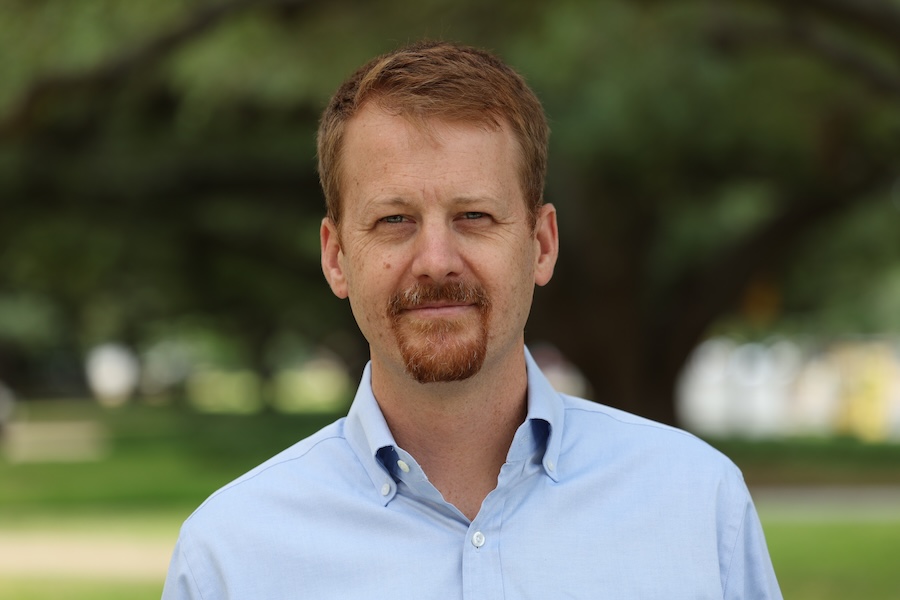
Baylor Photography: Robbie Rogers
Contact: Shelby Cefaratti-Bertin, 254-327-8012
Follow us: @BaylorUMedia on X and LinkedIn
Robert Elder, Ph.D., professor of history in Baylor University’s College of Arts & Sciences, has received the prestigious $60,000 Public Scholars grant from the National Endowment for the Humanities (NEH). Elder is the first Baylor faculty member to win in this category and one of only five Public Scholars grant recipients awarded this year. The Public Scholars program provides grants to individual authors to create and publish well-researched, nonfiction books in the humanities, aimed at a broad public audience.
“Being awarded the NEH Public Scholar grant is a real honor and a huge boost for my current book project,” Elder said. “Unlike some of the other grants offered by the NEH, the Public Scholar grant is designed for writers and academics who aim to communicate with broad, popular audiences beyond the university.”
Numerous projects received grant funding as part of NEH’s A More Perfect Union initiative, which focuses on exploring America’s story and celebrating 250 years of cultural heritage in advance of the 2026 Semiquincentennial of the signing of the Declaration of Independence. This special initiative leverages the humanities to promote a deeper understanding of America’s history and culture, advance civics education and knowledge of the nation’s core principles of government and preserve and provide access to the nation’s heritage.
Elder’s book, "The Crisis: Nullification and the Making of American Democracy," focuses on the 1832 nullification crisis, in which South Carolina initiated a state challenge to federal power by attempting to nullify federal tariffs. The political theory refers to the process by which a state has the right to invalidate any federal laws it deems unconstitutional. Elder began his work on the project over the summer and will continue through the 2025-2026 academic year.
“Despite its critical role in shaping our nation – it appears in every U.S. history textbook and every college survey course – there hasn't been a new book-length history of the nullification crisis for a general audience since William Freehling’s Prelude to Civil War in 1965,” Elder said. “My book aims to fill this significant gap, offering a fresh narrative that incorporates generations of new scholarship.”
“Only a handful of academics in the U.S. are named NEH Public Scholars each year, making it one of the most prestigious and competitive awards available to scholars in the humanities,” said Julie K. deGraffenried, Ph.D., associate professor and chair of the Department of History at Baylor. “Dr. Elder’s honor not only marks a well-deserved milestone in his own career, it also is representative of our departmental commitment to making excellent scholarship accessible to the widest possible audience.”
Elder’s research focuses on the cultural, intellectual and religious history of the American South in the 19th century, with a specialization in the Early Republic and the American South. He previously authored Calhoun: American Heretic, a biography of South Carolina Sen. John C. Calhoun, who was central to the nullification crisis. Elder’s latest book project is a natural extension of his scholarly field.
ABOUT BAYLOR UNIVERSITY
Baylor University is a private Christian University and a nationally ranked Research 1 institution. The University provides a vibrant campus community for more than 20,000 students by blending interdisciplinary research with an international reputation for educational excellence and a faculty commitment to teaching and scholarship. Chartered in 1845 by the Republic of Texas through the efforts of Baptist pioneers, Baylor is the oldest continually operating University in Texas. Located in Waco, Baylor welcomes students from all 50 states and more than 100 countries to study a broad range of degrees among its 12 nationally recognized academic divisions. Learn more about Baylor University at www.baylor.edu.
ABOUT THE COLLEGE OF ARTS & SCIENCES AT BAYLOR UNIVERSITY
The College of Arts & Sciences is Baylor University’s largest academic division, consisting of 25 academic departments in the sciences, humanities, fine arts and social sciences, as well as 11 academic centers and institutes. The more than 5,000 courses taught in the College span topics from art and theatre to religion, philosophy, sociology and the natural sciences. The College’s undergraduate Unified Core Curriculum, which routinely receives top grades in national assessments, emphasizes a liberal education characterized by critical thinking, communication, civic engagement and Christian commitment. Arts & Sciences faculty conduct research around the world, and research on the undergraduate and graduate level is prevalent throughout all disciplines. Visit the College of Arts & Sciences website.