

Baylor Geophysicist Helps Shape NASA’s Next Mission to the Moon
NASA selects Peter James, Ph.D., to serve on a prestigious SPARX Science Definition Team
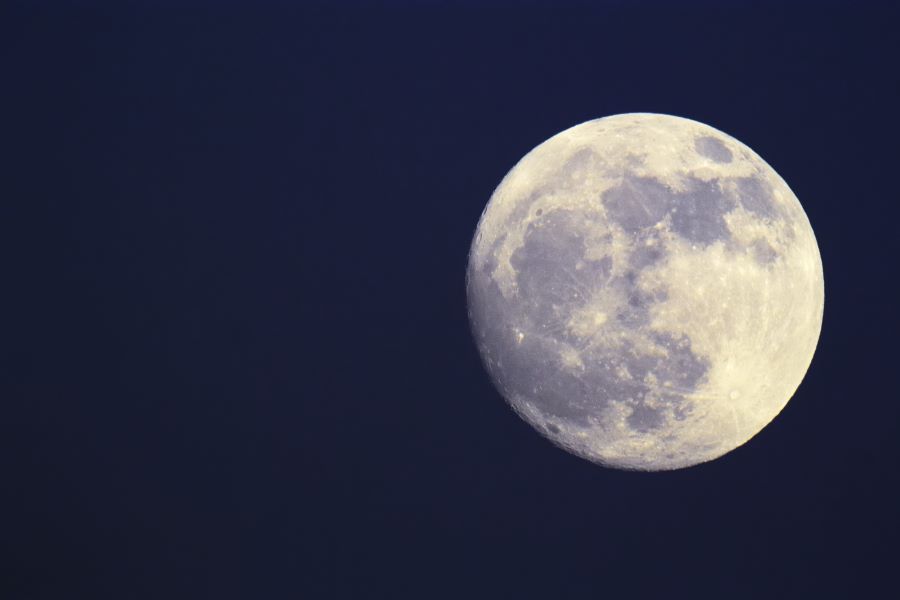
Photo Credit: getty images/Sjo
Contact: Kelly Craine, Baylor University Media and Public Relations, 254-297-9065
Follow us: @BaylorUMedia on X and LinkedIn
For Baylor University planetary geophysicist Peter B. James, Ph.D., exploring the Moon isn’t just about science – it’s about seeking out the mysteries of creation.

His work is both scientific and deeply meaningful. Quoting Proverbs 25:2, he reflected: “It is the glory of God to conceal things, but the glory of kings to search things out.”
“It feels like a privilege,” he said, “to explore creation through science.”
James has been selected to serve on a prestigious NASA Science Definition Team charged with shaping the goals and design of a future lunar mission. The South Pole-Aitken Basin Sample Return and eXploration (SPARX) Science Definition Team (SDT) will help determine the vision for a future robotic mission to the far side of the Moon, the highest priority strategic mission for NASA’s Lunar Discovery and Exploration Program. James joins team members from prominent universities and space agencies from around the world, including Johns Hopkins, University of Maryland/Goddard Space Flight Center, University of Florida, Arizona State University, Smithsonian Institution, Purdue University, University of Tokyo, NASA’s Jet Propulsion Laboratory, European Space Agency and Canadian Space Agency and more.
While the mission concept is still in development, the preliminary plan involves designing a long-range rover capable of traveling several hundred miles to collect geological samples from key sites across the South Pole-Aitken Basin.
Our job is to define the science objectives and technical requirements for a mission that could fundamentally expand how we understand the Moon’s geology. - Peter James, Ph.D.
“This is the ground floor of a long-term vision,” James said. “Our job is to define the science objectives and technical requirements for a mission that could fundamentally expand how we understand the Moon’s geology.”
James was selected for the SPARX team through a competitive process, based on his previous research on the geology of the South Pole-Aitken Basin. He brings expertise in planetary geophysics, particularly the Moon’s gravity field and internal structure. His contributions will help ensure that deeper geophysical questions are included alongside surface rock analyses.
From undergraduate research to interdisciplinary collaborations
Back at Baylor, James is integrating his NASA work into the classroom. He teaches a “Grand Challenges in Science” undergraduate course that guides non-science majors through the process of designing space missions – introducing them to spacecraft constraints, hypothesis testing and the societal impact of space exploration from a Christian worldview.
Graduate students in James’ Planetary Research Group also are contributing to lunar exploration efforts. From modeling crater structures to conducting fieldwork at Utah sites similar to future lunar landing zones, these students are helping lay the groundwork for the next generation of space science.
James also is involved in innovative interdisciplinary collaborations with researchers in Baylor’s School of Engineering and Computer Science. In collaboration with Alex Yokochi, Ph.D., associate dean of research and graduate programs and professor of materials, energy and chemical processes in the Department of Mechanical Engineering, and Annette von Jouanne, Ph.D., professor of energy systems in the Department of Electrical and Computer Engineering, the team has patented a magnetic levitation-based gravity sensor capable of detecting underground caves or dense rock on the Moon.
ABOUT PETER B. JAMES, PH.D.
Peter B. James, Ph.D., associate professor of planetary geophysics at Baylor University, served on the science team of three NASA missions: the Lunar Reconnaissance Orbiter (LRO), the Gravity Recovery and Interior Laboratory (GRAIL), and the MErcury Surface, Space ENvironment, GEochemistry, and Ranging (MESSENGER) mission. In 2025, he was selected to serve on NASA’s South Pole-Aitken Basin Sample Return and eXploration (SPARX) Science Definition Team (SDT) that will shape the goals and design of a future lunar mission. James is the founder of Baylor’s Planetary Research Group, which pursues research with spacecraft data to study the crusts and mantles of planets and moons in the Solar System. He earned his Ph.D. from the Massachusetts Institute of Technology.
ABOUT BAYLOR UNIVERSITY
Baylor University is a private Christian University and a nationally ranked Research 1 institution. The University provides a vibrant campus community for more than 20,000 students by blending interdisciplinary research with an international reputation for educational excellence and a faculty commitment to teaching and scholarship. Chartered in 1845 by the Republic of Texas through the efforts of Baptist pioneers, Baylor is the oldest continually operating University in Texas. Located in Waco, Baylor welcomes students from all 50 states and more than 100 countries to study a broad range of degrees among its 12 nationally recognized academic divisions. Learn more about Baylor University at www.baylor.edu.
ABOUT THE COLLEGE OF ARTS & SCIENCES AT BAYLOR UNIVERSITY
The College of Arts & Sciences is Baylor University’s largest academic division, consisting of 25 academic departments in the sciences, humanities, fine arts and social sciences, as well as 11 academic centers and institutes. The more than 5,000 courses taught in the College span topics from art and theatre to religion, philosophy, sociology and the natural sciences. The College’s undergraduate Unified Core Curriculum, which routinely receives top grades in national assessments, emphasizes a liberal education characterized by critical thinking, communication, civic engagement and Christian commitment. Arts & Sciences faculty conduct research around the world, and research on the undergraduate and graduate level is prevalent throughout all disciplines. Visit the College of Arts & Sciences website.