

Baylor Cancer Researcher Earns Coveted NSF CAREER Award for Elite Early Career Faculty
Liela Romero, Ph.D., will pursue new synthetic tools, derived from earth-abundant metals, to aid in the development of drug leads and more
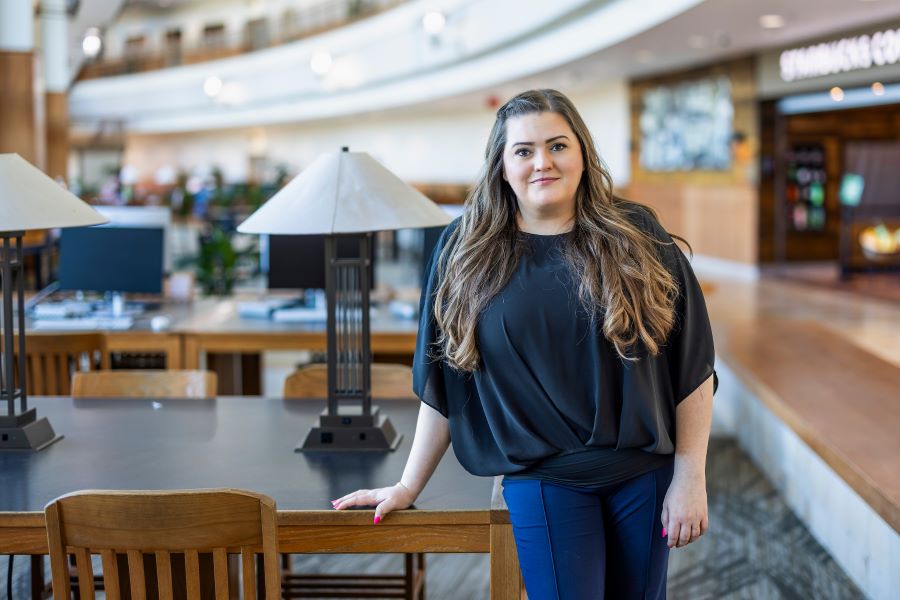
Liela Romero, Ph.D., B.S.’ 11, associate professor of chemistry and biochemistry at Baylor University and recipient of an Early Career Development Award (CAREER) from the National Science Foundation. (Matthew Minard/Baylor University)
Contact: Lori Fogleman, 254-709-5959
Follow us: @BaylorUMedia on X and LinkedIn
Liela Romero, Ph.D., B.S.’ 11, associate professor of chemistry and biochemistry at Baylor University, has earned a coveted Early Career Development Award (CAREER) from the National Science Foundation (NSF) to further her research in the development of new tools for chemical synthesis and drug discovery. Through the award, Romero will focus specifically on the chemistry of earth-abundant metals such as zirconium complexes as catalysts for approaches that are more efficient, cost less and are less toxic than some metals commonly used in chemical synthesis.
“The NSF CAREER Award is one that, as a junior faculty member, you hope to accomplish,” Romero said. “I’m grateful that the NSF has shown faith in our group and our ability to work on new, meaningful approaches to fundamental chemistry.”
The NSF describes the CAREER program and its recipients as the “National Science Foundation's most prestigious awards in support of early-career faculty who have the potential to serve as academic role models in research and education and to lead advances in the mission of their department or organization.” The commensurate funding with the award will supply $660,000 over five years to Romero’s work.
“National Science Foundation CAREER Awards are a prestigious recognition of research excellence by early-career faculty members, and we’re grateful to see Dr. Liela Romero chosen for this elite award and honor,” Baylor Provost Nancy Brickhouse, Ph.D., said. “CAREER Awards demonstrate that a faculty member is generating cutting-edge research addressing national priorities and challenges. We look forward to seeing the fruits of Dr. Romero’s work as she develops new strategies for chemical synthesis to advance her field.”
"CAREER Awards demonstrate that a faculty member is generating cutting-edge research addressing national priorities and challenges. We look forward to seeing the fruits of Dr. Romero’s work as she develops new strategies for chemical synthesis to advance her field.”
Baylor University Provost Nancy Brickhouse, Ph.D.
A 2011 Baylor chemistry and biochemistry graduate, Romero returned to her alma mater in 2020 with the support of a $2 million Cancer Prevention and Research Institute of Texas (CPRIT) grant. The CPRIT grant was designated for “emerging investigators pursuing their first faculty appointment who are expected to make outstanding contributions in cancer research,” and Romero’s CAREER Award five years later demonstrates her such contributions taking place in the state of Texas.
“Winning a CAREER award is a most prestigious recognition from the National Science Foundation, conferred to a limited number of outstanding early-career faculty across the country,” said Lee C. Nordt, Ph.D., dean of the Baylor College of Arts & Sciences. “Dr. Romero's research and teaching achievements at Baylor have been exemplary and have contributed to our University receiving Research 1 standing among the nation’s top-tier research institutions.”
“Liela Romero has established herself as an outstanding researcher in the field of chemical synthesis, reaction development and drug discovery, and her CAREER Award highlights the value others see in her contributions,” said John L. Wood, Ph.D., The Robert A. Welch Distinguished Professor and chair of the Department of Chemistry and Biochemistry. “We’re grateful that Liela, as an alumna of Baylor University and the Department of Chemistry and Biochemistry, returned to her alma mater and look forward to seeing the fruits of her work on this and other projects.”
Research with impact: From cancer drugs to water bottles
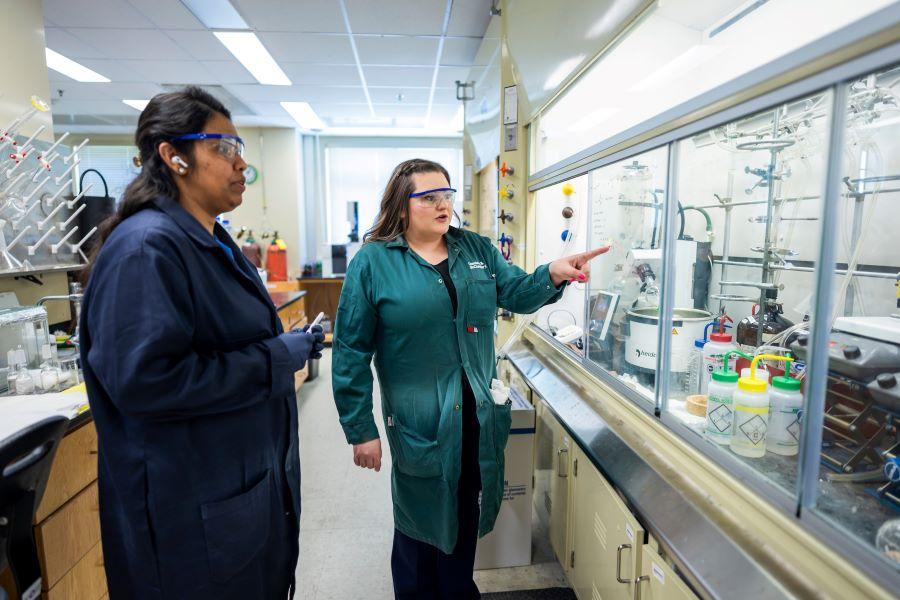
An organic chemist, Romero describes herself as a “chef” who mixes individual elements from natural products together to create synthetic products with stronger applications for cancer-fighting drug leads and more.
“A large portion of new therapeutic drug leads have historically come from natural products or are derived from some form of natural products,” Romero said. “In my work, I’m interested in exploring them and developing new chemical strategies to understand where this anti-cancer activity is derived from in order to further improve the efficacy and therapeutic potential of these small molecules.”
Synthetic access to these natural products, however, often requires the development of new or more efficient chemical tools, with metals serving as catalysts for the reactions they study. The CAREER Award will focus her attention on earth-abundant metals for applications that use less of these chemicals to add efficiency in the amount of metals used, cost and toxicity to the process. Romero said applications for the work extend to a variety of sectors.
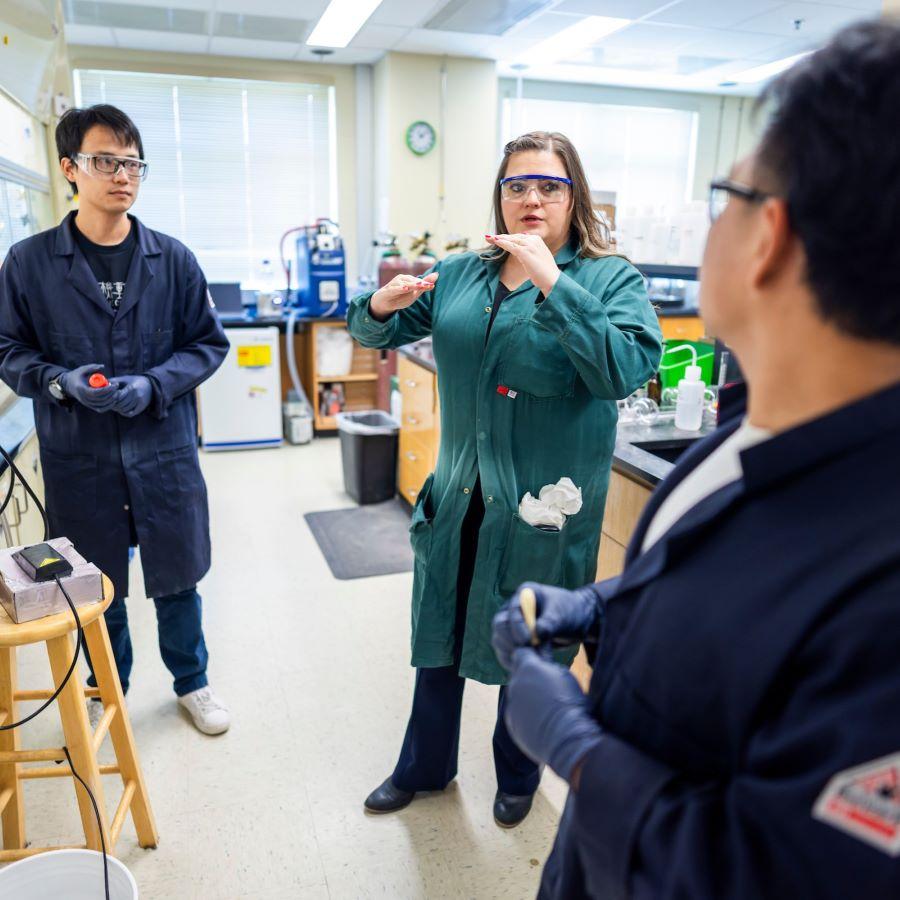
“We’ve seen interest in this chemistry from both a sustainability standpoint and its potential applicability to large-scale processing of plastic waste, like that found in the average water bottle,” said Romero, who recently was named a 2025 Scialog Fellow in Sustainable Minerals, Metals, and Materials through the Research Corporation For Science Advancement. “We’re also hearing from chemists in the pharmaceutical industry that are trying to access necessary therapeutics, but don’t have all the chemical tools they need. Our hope is that we are contributing directly to these efforts by developing new strategies for them.”
In addition to the research component of the CAREER award, Romero will pursue the development of educational opportunities associated with the award for students with visual impairment, along with chemistry and biochemistry colleague Bryan F. Shaw, Ph.D., and will co-organize and further Baylor’s offerings at Advanced Instrumentation Workshops for educators and students across Texas.
ABOUT BAYLOR UNIVERSITY
Baylor University is a private Christian University and a nationally ranked Research 1 institution. The University provides a vibrant campus community for more than 20,000 students by blending interdisciplinary research with an international reputation for educational excellence and a faculty commitment to teaching and scholarship. Chartered in 1845 by the Republic of Texas through the efforts of Baptist pioneers, Baylor is the oldest continually operating University in Texas. Located in Waco, Baylor welcomes students from all 50 states and more than 100 countries to study a broad range of degrees among its 12 nationally recognized academic divisions.
ABOUT THE COLLEGE OF ARTS & SCIENCES AT BAYLOR UNIVERSITY
The College of Arts & Sciences is Baylor University’s largest academic division, consisting of 25 academic departments in the sciences, humanities, fine arts and social sciences, as well as 11 academic centers and institutes. The more than 5,000 courses taught in the College span topics from art and theatre to religion, philosophy, sociology and the natural sciences. The College’s undergraduate Unified Core Curriculum, which routinely receives top grades in national assessments, emphasizes a liberal education characterized by critical thinking, communication, civic engagement and Christian commitment. Arts & Sciences faculty conduct research around the world, and research on the undergraduate and graduate level is prevalent throughout all disciplines. Visit the College of Arts & Sciences website.